Zalman or Apevia? PC Cases Compared in 2026
As an Amazon Associate we earn from qualifying purchases. Links on this page are affiliate links.
This guide compares the Zalman ARGB controller hub against the Apevia Prodigy PC case. While both products address lighting and case needs, they serve different roles in your build. The primary keyword is zalman vs apevia PC case. Zalman offers a dedicated hub for managing addressable RGB fans, whereas Apevia provides a complete Micro-ATX chassis with pre-installed fans. You need to decide between adding a lighting controller to an existing case or buying a new case with integrated lighting solutions.
Key differences
| Aspect | Zalman 4-Port ARGB Controller Hub | Apevia Prodigy Micro-ATX Case |
|---|---|---|
| Product Type | ARGB Controller Hub | Micro-ATX PC Case |
| Motherboard Support | Not listed | Micro-ATX, Mini-ITX |
| Lighting Control | 4-port hub with push button | Top I/O panel with 16 modes |
| Pre-installed Fans | Not listed | 3x RGB fans |
| Side Panel | Not listed | Tempered glass window |
Which one should you choose?
Choose Zalman 4-Port ARGB Controller Hub if
- You already have a case and need to manage 4 separate ARGB headers independently.
- You prefer physical button control for lighting patterns without motherboard software.
- You want a compact magnetic hub that fits easily behind a motherboard tray.
Choose Apevia Prodigy Micro-ATX Case if
- You are building a new Micro-ATX or Mini-ITX system from scratch.
- You want a case that includes three RGB fans and a tempered glass side panel.
- You prefer customizable lighting modes accessible directly from the top I/O panel.
Verdict: Choose the Zalman hub if you need a dedicated lighting controller for existing components. Pick the Apevia case if you require a complete chassis with integrated RGB fans and tempered glass visibility.
Zalman Controller vs Apevia Case
Product Role
These two items serve completely different functions in your PC build. The Apevia Prodigy is a full Micro-ATX case that houses your components. It includes a tempered glass side panel and pre-installed RGB fans. The Zalman unit is a small 4-port ARGB controller hub. It manages lighting for up to four ARGB devices. It does not house hardware. You need the Apevia case to build a computer. The Zalman hub is an accessory for lighting control only.
Motherboard Support
The Apevia Prodigy case supports Micro-ATX and Mini-ITX motherboards. This gives you flexibility in choosing your main system board. The Zalman controller has no motherboard support because it is not a case. It connects via SATA power and ARGB headers. It does not replace a chassis. If you need a home for your motherboard, the Apevia case is the only viable option here. The Zalman hub is a supplementary component for lighting management.
Lighting Control
The Apevia case offers 16 lighting modes via its top I/O panel. It uses proprietary RGB fans with inner and outer glow rings. You can choose from 30 play-through options. The Zalman hub controls up to four sets of 3-pin ARGB headers. It allows independent control or sync with your motherboard. It also features a push-button control option. The Apevia handles case-wide RGB patterns. The Zalman manages individual ARGB devices. Both provide lighting solutions but through different methods.
Cooling Capacity
The Apevia Prodigy supports up to six 120mm fans. It also accepts 120mm radiators on the rear panel. This allows for significant airflow or liquid cooling options. The Zalman controller has no cooling capacity. It is an electronic hub with no fans or radiators. It does not contribute to thermal performance. For cooling, the Apevia case provides the hardware. The Zalman hub is purely for lighting synchronization and control.
Physical Size
The Apevia case measures 15.6 inches in height, 16.1 inches in length, and 7.95 inches in width. It weighs 13 pounds. It is a substantial chassis for your components. The Zalman controller is tiny. It measures 1.77 inches in length, 1.14 inches in width, and 0.55 inches in height. It has a magnetic bottom for placement. The Apevia is the main structure. The Zalman is a small add-on component that fits inside or near your case.
Which PC Component Should You Choose
You need a full Micro-ATX case with fans
The Apevia Prodigy is a complete Micro-ATX case with a tempered glass side panel. It includes three pre-installed RGB fans and supports video cards up to 350mm. You get a ready-to-build chassis with room for up to six 120mm fans. It is the only option here that houses your components.
You want to add ARGB control to existing fans
The Zalman ZM-4PALC is a dedicated hub for four 5V 3-pin ARGB devices. It allows independent control without motherboard headers. You can sync lighting via motherboard or use the push button. Its compact 1.77-inch length and magnetic bottom make it easy to mount inside your existing case.
You need a case with pre-installed lighting
The Apevia Prodigy comes with three RGB fans already installed. You can cycle through 16 lighting modes using the top I/O panel button. It supports Micro-ATX and Mini-ITX motherboards. This all-in-one solution saves you the step of buying and mounting fans separately.
You have extra ARGB strips needing a hub
The Zalman controller handles up to four sets of ARGB headers. It connects via SATA power and offers a 2-pin switch port for case buttons. You can change patterns with a single push. It fits small spaces with its 0.55-inch height.
The products compared

Zalman 4-Port ARGB Controller Hub
Best for: manual 5V 3-pin ARGB control
- Lighting
- ARGB
- Connector Type
- 3-Pin
- Dimensions
- 1.77 × 1.14 × 0.55 inches
View on Amazon: Zalman 4-Port ARGB Controller Hub Affiliate link
This Zalman ZM-4PALC hub manages four 5V 3-pin ARGB channels. You connect ARGB devices to the hub and power it via SATA. The unit features a magnetic base for flexible placement inside your case. It includes a push-button control linked to a case switch. This controller allows independent lighting management without relying on motherboard headers.
Pros
- Supports up to four 5V 3-pin ARGB headers
- Magnetic bottom for flexible case placement
- Push-button control via 2-pin case switch
- Connects via standard SATA power
Cons
- No software or app control listed
- Requires manual button pressing for changes
- Limited to 5V 3-pin ARGB devices only
Good fit if
- You need to control ARGB without motherboard headers
- You prefer physical button control over software
- You have multiple 5V 3-pin ARGB devices
Skip if
- You require software-based lighting synchronization
- You use 12V 4-pin RGB devices
- You want remote control functionality
Verdict: Zalman ARGB Controller 4-Port Hub fits builders who want simple, hardware-based control for 5V 3-pin ARGB strips without using motherboard headers.
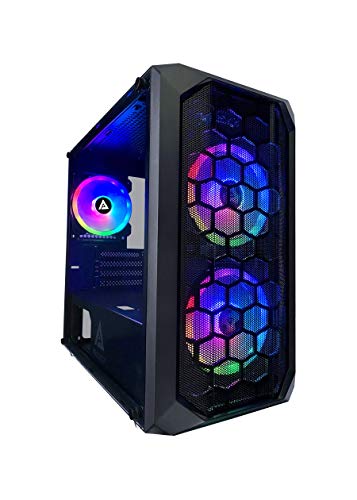
Apevia Prodigy Micro-ATX Case
Best for: Compact Micro-ATX builds with RGB focus
- Motherboard Support
- Micro-ATX, Mini-ITX
- Case Type
- Micro-ATX
- Side Panel
- Tempered Glass
- Included Fans
- 3x RGB
- Radiator Support
- 120mm
- Max GPU Length
- 350mm
View on Amazon: Apevia Prodigy Micro-ATX Case Affiliate link
The Apevia PRODIGY-BK is a Micro-ATX case with a tempered glass side panel and mesh front. It includes three preinstalled RGB fans and supports up to six 120mm fans for cooling. You get 350mm GPU clearance and 165mm CPU cooler height. The top I/O panel offers 16 lighting modes. This compact build suits gamers who want visible internals without the bulk of a full tower.
Pros
- Tempered glass side panel for visibility
- Three preinstalled RGB fans included
- Supports GPUs up to 350mm long
- Room for up to six 120mm fans
- 16 lighting modes via top I/O panel
Cons
- Only supports Micro-ATX and Mini-ITX motherboards
- Radiator support limited to 120mm size
- Proprietary fans restrict third-party upgrades
Good fit if
- You need a compact case for Micro-ATX boards
- You want preinstalled RGB lighting
- You prefer a mesh front for airflow
Skip if
- You require ATX motherboard support
- You need large radiator support
- You want full tower dimensions
Verdict: Apevia PRODIGY-BK Micro-ATX Case fits users who want a small footprint with visible RGB lighting and standard cooling options.
Specifications side by side
| Spec | Zalman 4-Port ARGB Controller Hub | Apevia Prodigy Micro-ATX Case |
|---|---|---|
| Motherboard Support | not stated | Micro-ATX, Mini-ITX |
| Case Type | not stated | Micro-ATX |
| Side Panel | not stated | Tempered Glass |
| Included Fans | not stated | 3x RGB |
| Radiator Support | not stated | 120mm |
| Max GPU Length | not stated | 350mm |
| Use | not stated | Gaming |
| Lighting | ARGB | RGB |
| Connectivity | not stated | USB 3.0 |
| Connector Type | 3-Pin | not stated |
| Dimensions | 1.77 × 1.14 × 0.55 inches | 16.1 × 7.95 × 15.6 inches |
| Weight | not stated | 13 pounds |
| Color | Black | Black |
| Model | ZM-4PALC | PRODIGY-BK |
| Size | not stated | PRODIGY BLACK |
Frequently asked questions
Is Zalman a PC case manufacturer?
No, Zalman does not manufacture PC cases in this comparison. The brand offers the 4-Port ARGB Controller Hub instead. This accessory manages lighting for 5V 3-pin ARGB strips. It provides hardware-based control without using motherboard headers. You use it to enhance lighting in cases made by other brands.
Does Apevia make budget PC cases?
Apevia produces the Prodigy Micro-ATX case, which targets compact builds. It features a small footprint suitable for smaller desks. The case includes pre-installed RGB fans and a tempered glass side panel. It supports standard cooling options and video cards up to 350mm in length.
Can I control ARGB without motherboard headers?
Yes, you can use the Zalman 4-Port ARGB Controller Hub. It connects to 5V 3-pin ARGB strips directly. This allows manual control of lighting effects. You do not need to reserve motherboard headers for this task. It fits builders who prefer simple hardware-based management.
What size motherboard does the Apevia case support?
The Apevia Prodigy supports Micro-ATX motherboards. It is designed for compact builds with a limited footprint. The dimensions are 7.95 inches wide, 15.6 inches high, and 16.1 inches long. It weighs 13 pounds, making it a sturdy option for small form factor PCs.
What is the difference between RGB and ARGB?
RGB lights all LEDs in a strip with a single color. ARGB allows individual LEDs to display different colors. The Apevia case uses standard RGB fans. The Zalman hub controls 5V 3-pin ARGB strips. This hub lets you manage complex lighting patterns separately from the case fans.
Does the Zalman hub work with any case?
The Zalman 4-Port ARGB Controller Hub works with any case that has compatible 5V 3-pin ARGB strips. It is not a case itself. It is an accessory that manages lighting. You can install it inside any case that has space for a 1.77-inch long device.
Is the Apevia Prodigy good for gaming?
Yes, the Apevia Prodigy is listed for gaming use. It includes pre-installed RGB fans for visual appeal. The case supports video cards up to 350mm long. It offers a tempered glass side panel to showcase your internal components. It is a compact option for gaming builds.