darkFlash ATX Mid-Tower Dual Glass vs darkFlash ATX Mid-Tower Digital Display (2026): Key Differences
As an Amazon Associate we earn from qualifying purchases. Links on this page are affiliate links.
When comparing darkflash atx mid tower dual glass vs atx mid tower digital display, you face a choice between visual purity and functional data. Both are darkFlash ATX mid-tower cases with four PWM ARGB fans and 360mm radiator support. They share Type-C connectivity and tempered glass panels. The main difference lies in the exterior design. One offers a classic dual-glass panoramic view, while the other adds a digital display for real-time system monitoring. This distinction shapes their appeal for different builders.
Key differences
| Aspect | darkFlash ATX Mid-Tower Dual Glass Case | darkFlash ATX Mid-Tower with Digital Display |
|---|---|---|
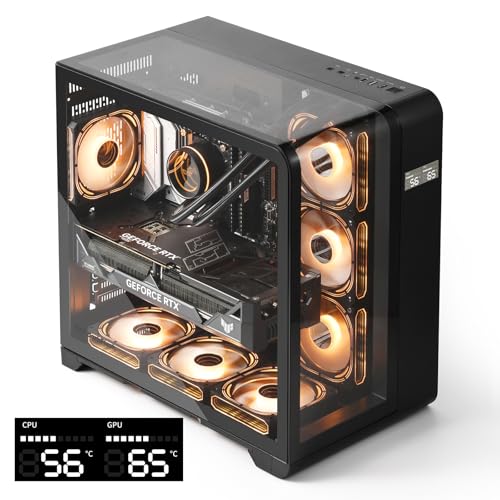
| Side Panel Design | Dual tempered glass panels for 270° panoramic view | Three glass panels with curved design and digital display |
| Digital Display | Not listed | Real-time CPU and GPU temperature and usage monitoring |
| Dust Filter Location | Top of the case and panel dust filter | Bottom of the case |
| Dimensions | 17.1"L x 8.5"W x 17.8"H | 11"L x 16.2"W x 16.3"H |
Which one should you choose?
Choose darkFlash ATX Mid-Tower Dual Glass Case if
- You prefer a clean, unobstructed 270° panoramic view of your hardware without any screens
- You want dust filters located at the top to prevent debris from falling onto components
- You prioritize a taller case profile for easier cable management and component access
Choose darkFlash ATX Mid-Tower with Digital Display if
- You want real-time visibility into CPU and GPU temperatures and usage via a built-in display
- You prefer a unique three-glass curved design that serves as a centerpiece
- You need specific mounting holes on the case back for precise component installation
Verdict: Choose the Dual Glass model if you want a classic, wide-angle showcase of your build with top-mounted dust filtration. Pick the Digital Display model if you value real-time system monitoring and a distinctive curved glass aesthetic. Both offer strong airflow and ARGB lighting for gaming setups.
Dual Glass vs Digital Display Specs
side panel design
The darkFlash ATX Mid-Tower Dual Glass Case offers a 270° panoramic view through its full-view tempered glass panels. This design prioritizes aesthetics, giving you an expansive look at your hardware and RGB lighting. In contrast, the darkFlash ATX Mid-Tower with Digital Display features a unique three-glass design with curved panels. This curved approach enhances the visual appeal while still providing optimal visibility. Both cases use high-strength tempered glass for durability and clarity. If you prefer a classic, wide-angle showcase, the Dual Glass model fits well. If you want a more modern, curved aesthetic, the Digital Display version stands out. Each design serves different visual preferences without compromising on material quality.
digital monitoring
The darkFlash ATX Mid-Tower with Digital Display includes a built-in screen for real-time system monitoring. This feature allows you to track CPU and GPU temperature and usage directly on the case. It ensures you are always aware of your system's operating status and can optimize performance accordingly. The darkFlash ATX Mid-Tower Dual Glass Case does not list any digital display or monitoring capabilities in its specifications. It relies on traditional airflow and fan management for cooling. For users who want immediate visual feedback on hardware health without opening software, the Digital Display model offers a clear advantage. If you do not need on-case data, the Dual Glass case remains a solid choice.
gpu compatibility
The darkFlash ATX Mid-Tower with Digital Display explicitly supports GPUs up to 410mm in length. This spacious interior accommodates the latest large graphics cards, ensuring compatibility with high-end hardware. The darkFlash ATX Mid-Tower Dual Glass Case does not list a maximum GPU length in its provided specifications. While it is an ATX mid-tower, the exact clearance is not defined in the data. If you are building with a very large graphics card, the Digital Display case gives you a confirmed limit of 410mm. For standard-sized cards, both cases likely perform well, but the Digital Display model provides more specific assurance for bulky components.
storage capacity
The darkFlash ATX Mid-Tower with Digital Display supports up to 3 SSDs and 2 HDDs. This maximum storage capacity is ideal for users who need extensive space for games, media, and system files. The darkFlash ATX Mid-Tower Dual Glass Case does not list specific storage drive limits in its specifications. It focuses on airflow and installation ease rather than detailed storage counts. If you plan to install multiple mechanical hard drives alongside solid-state drives, the Digital Display model offers a clear advantage with its defined 3 SSD and 2 HDD support. The Dual Glass case may have similar internal space, but the exact drive count is not confirmed in the data.
dust filtration
Both cases include thoughtful dust filtration designs to protect internal components. The darkFlash ATX Mid-Tower Dual Glass Case features a magnetic dust filter at the top and a panel dust filter to reduce dust accumulation. The darkFlash ATX Mid-Tower with Digital Display includes a dust filter at the bottom of the case. Both designs help keep components clean and free from debris. The Dual Glass model offers top and panel filtering, while the Digital Display model focuses on bottom filtration. Neither case lists a comprehensive set of filters for all intake points in the provided data. You should choose based on your preferred airflow direction and dust management strategy, as both provide essential protection.
Which Case Fits Your Build Best
You want a clean, classic aesthetic
The Dual Glass Case features a 270-degree panoramic tempered glass design. This offers an unobstructed view of your internal components without distracting elements. You get a traditional, sleek look that highlights your hardware. The magnetic dust filters help keep the interior clean. This choice prioritizes visual purity and a minimalist gaming setup.
You need real-time system monitoring
The Digital Display Case includes a built-in screen for real-time CPU and GPU monitoring. You can track temperature and usage directly on the chassis. This feature helps you optimize performance and check system status instantly. It combines aesthetic appeal with practical utility, making it ideal for users who value data visibility during intense sessions.
You have a large graphics card
This model supports GPUs up to 410mm in length. The spacious interior layout accommodates the latest large hardware easily. You benefit from a snap-on design for hassle-free installation. The case also supports up to 3 SSDs and 2 HDDs. This flexibility ensures your build fits comfortably without crowding.
You prefer a wider chassis layout
The Dual Glass Case has a width of 8.6 inches. This provides a broader footprint for cable management and component placement. You enjoy a user-friendly design with quick access to parts. The anti-slip bottom structure prevents sliding on various surfaces. This stability and width make upgrades and maintenance straightforward for your build.
The products compared

darkFlash ATX Mid-Tower Dual Glass Case
Best for: RGB visibility and high airflow cooling
- Case Type
- Mid-Tower
- Side Panel
- Tempered Glass
- Included Fans
- 4x PWM ARGB
- Radiator Support
- 360mm
- Motherboard Support
- ATX
- Use
- Gaming
View on Amazon: darkFlash ATX Mid-Tower Dual Glass Case Affiliate link
This darkFlash ATX mid-tower case features a dual tempered glass design for a 270-degree panoramic view of your components. It comes pre-installed with four PWM ARGB fans and supports up to ten fans total, including 360mm radiators. The IO panel includes USB 3.0 and Type-C ports. It suits builders who want high airflow and visible RGB lighting without extra hubs.
Pros
- Pre-installed 4x PWM ARGB fans
- Dual tempered glass side panels
- Supports up to 10 fans and 360mm radiators
- USB 3.0 and Type-C connectivity
Cons
- RGB hub controller not included
- No digital display for monitoring
- Limited to ATX motherboard size
Good fit if
- You want a clear view of internal RGB lighting
- You need strong airflow for high-end components
- You prefer pre-installed fans for easier assembly
Skip if
- You require a built-in digital display
- You need a controller included for ARGB fans
- You prefer a single side glass design
Verdict: The darkFlash DS900 ATX Mid-Tower Dual Glass delivers excellent visibility and cooling support for RGB-focused builds. It is a solid choice for gamers who want to showcase their hardware and airflow capabilities.
darkFlash ATX Mid-Tower with Digital Display
Best for: Users wanting triple-glass visibility and built-in stats
- Motherboard Support
- ATX
- Case Type
- Mid-Tower
- Side Panel
- Glass
- Included Fans
- 4 PWM ARGB
- Radiator Support
- 360mm
- Max GPU Length
- 410mm
View on Amazon: darkFlash ATX Mid-Tower with Digital Display Affiliate link
The darkFlash L280 ATX Mid-Tower features three glass panels and a digital display for real-time CPU and GPU monitoring. It includes four pre-installed PWM ARGB fans and supports GPUs up to 410mm and 360mm radiators. This case suits users who want a unique aesthetic with visible internals and basic hardware tracking without needing external software.
Pros
- Three-glass design with curved side panel for full visibility
- Built-in digital display for CPU and GPU temperature and usage
- Includes four pre-installed PWM ARGB fans
- Supports large 410mm GPUs and 360mm radiators
- Type-C connectivity port included
Cons
- RGB hub controller is not included
- Digital display only shows basic stats, not full system metrics
- Heavier build at 16.5 pounds compared to standard mid-towers
Good fit if
- You want a case with three glass panels for maximum visibility
- You prefer hardware monitoring via a built-in screen rather than software
- You need space for large GPUs and radiators
Skip if
- You require an included RGB hub controller for fan management
- You need a compact MATX build instead of ATX
- You prefer a single glass panel design for simplicity
Verdict: The darkFlash L280 ATX Mid-Tower is a solid choice for builders who value the unique three-glass aesthetic and want basic hardware monitoring via its integrated display. It fits those who prioritize visual impact and pre-installed lighting over advanced software control.
Specifications side by side
| Spec | darkFlash ATX Mid-Tower Dual Glass Case | darkFlash ATX Mid-Tower with Digital Display |
|---|---|---|
| Motherboard Support | not stated | ATX |
| Case Type | Mid-Tower | Mid-Tower |
| Side Panel | Tempered Glass | Glass |
| Included Fans | 4x PWM ARGB | 4 PWM ARGB |
| Radiator Support | 360mm | 360mm |
| Max GPU Length | not stated | 410mm |
| Tower Size | Mid-Tower | Mid-Tower |
| Use | Gaming | Gaming |
| Lighting | ARGB | ARGB |
| Connectivity | Type-C | Type-C |
| Compatible Device | Radiator | not stated |
| Dimensions | 8.6 × 17.8 × 17 inches | 11 × 16.2 × 16.3 inches |
| Weight | 15 pounds | 16.5 pounds |
| Size | 17.1''L x 8.5''W x 17.8'H | not stated |
| Color | Black | Black |
| Model | DS900 | L280 |
Frequently asked questions
Does the darkFlash Dual Glass case have a digital display?
No, the darkFlash DS900 Dual Glass case does not include a digital display. It focuses on visual purity with tempered glass side panels for a clear view of your hardware. If you need real-time system stats, you should consider the L280 model instead, which integrates a display for monitoring purposes.
Is the darkFlash L280 case heavier than the DS900?
Yes, the darkFlash L280 is slightly heavier. It weighs 16.5 pounds, while the DS900 Dual Glass case weighs 15 pounds. This difference may matter if you plan to move your PC frequently. Both cases are built for stability, but the L280’s extra weight comes from its additional glass panels and display hardware.
Which case is wider, the Dual Glass or the Digital Display?
The darkFlash ATX Mid-Tower Dual Glass (DS900) is wider. Its width is 17.8 inches, compared to the L280 Digital Display case, which is 16.2 inches wide. You should check your desk space before purchasing. The DS900’s larger footprint provides a more expansive look, while the L280 has a more compact width.
Does the L280 Digital Display case support ATX motherboards?
Yes, the darkFlash L280 ATX Mid-Tower with Digital Display supports ATX motherboards. It is designed to fit standard ATX form factor boards. This compatibility ensures it works with most mainstream gaming and productivity builds. You can install your motherboard without worrying about size constraints within this mid-tower chassis.
Can I install a 360mm radiator in both cases?
Yes, both cases support 360mm radiators. The DS900 Dual Glass and the L280 Digital Display both offer this cooling capacity. This means you can use large liquid cooling loops in either chassis. Both models are equipped with four PWM ARGB fans to help manage temperatures alongside your radiator setup.
Does the Dual Glass case have Type-C connectivity?
Yes, the darkFlash DS900 Dual Glass case includes Type-C connectivity. You can connect high-speed devices directly to the front panel. This feature is also available on the L280 Digital Display case. Both models provide modern port options for convenient access to your peripherals without reaching behind the desk.
Is the L280 case suitable for RGB-focused builds?
Yes, the darkFlash L280 is suitable for RGB builds. It includes ARGB lighting to complement your internal components. While it also features a digital display, the lighting remains a key aesthetic feature. This makes it a good choice if you want both visual flair and functional monitoring in one package.