Corsair vs ASUS PC Cases: Which Brand Fits You?
As an Amazon Associate we earn from qualifying purchases. Links on this page are affiliate links.
When you compare corsair vs ASUS PC case options, you look at full-tower designs built for ambitious builds. Both cases support large motherboards and offer extensive cooling potential for high-end hardware. The main difference lies in their specific motherboard compatibility and cooling configurations. Corsair focuses on massive airflow and cable management, while ASUS emphasizes E-ATX support and visual customization. Understanding these specs helps you pick the right chassis for your components.
Key differences
| Aspect | Corsair 7000D Airflow Full-Tower Case | ASUS TUF Gaming E-ATX Full-Tower Case |
|---|---|---|
| Motherboard Support | ATX | E-ATX |
| Tower Size | Full-Tower | Full-Tower |
| Included Fans | 3x 140mm | 3x 120mm, 1x 140mm |
| Radiator Support | 420mm | 360mm |
| Side Panel | not listed | Tempered Glass |
Which one should you choose?
Choose Corsair 7000D Airflow Full-Tower Case if
- You need support for large 420mm radiators for extreme cooling.
- You prefer a design focused on high-airflow front panels and cable management.
- You are building with standard ATX motherboards.
Choose ASUS TUF Gaming E-ATX Full-Tower Case if
- You require E-ATX motherboard support for larger boards.
- You want a tempered glass side panel for visibility.
- You prefer RGB lighting integration with Aura Sync.
Verdict: Choose the Corsair 7000D Airflow if you prioritize maximum cooling capacity and cable management for ATX builds. Pick the ASUS TUF Gaming GT501 if you need E-ATX support and a tempered glass side panel for a visual showcase. Both are full-tower cases, so your choice depends on motherboard size and cooling needs.
Corsair vs ASUS Case Specs
Motherboard Support
The Corsair 7000D Airflow is designed for standard ATX motherboards. This is a common form factor that fits most mid-range to high-end builds. The ASUS TUF Gaming GT501 goes further by supporting E-ATX motherboards. This larger format allows for more expansion slots and larger PCBs. If you plan to use a massive enthusiast motherboard with extra PCIe slots, the ASUS option provides the necessary physical space. The Corsair model may not accommodate these larger boards. Choose the ASUS unit if your motherboard exceeds standard ATX dimensions.
Radiator Support
Cooling capacity differs between these two full-tower cases. The Corsair 7000D Airflow supports up to three simultaneous 360mm radiators or two 420mm radiators. This setup allows for extreme cooling potential across multiple loops or a very large single loop. The ASUS GT501 supports 360mm radiators on the top or front, plus a 140mm radiator at the rear. It does not list support for 420mm radiators. If you need to mount multiple large radiators simultaneously for maximum heat dissipation, the Corsair design offers superior flexibility and volume.
Included Fans
Both cases ship with fans, but the specifications vary. The Corsair 7000D Airflow includes three 140mm AirGuide fans. These larger fans move more air at lower speeds, which can reduce noise. The ASUS GT501 includes three 120mm Aura Sync RGB fans and one 140mm rear PWM fan. The ASUS option provides four fans total, with three featuring RGB lighting. The Corsair fans use anti-vortex vanes to concentrate airflow. The ASUS fans prioritize visual customization through RGB sync. You get more fans with the ASUS case, but larger fans with Corsair.
Side Panel Material
The visual transparency of the case sides is a key choice. The ASUS GT501 features a 4mm-thick smoked, tempered-glass full view side panel. This allows you to see the internal components clearly while offering durability. The Corsair 7000D Airflow data does not specify the side panel material. It mentions a high-airflow optimized steel front panel, but the side construction is not listed in the provided specifications. If seeing your hardware is important, the ASUS tempered glass is a confirmed feature. The Corsair side material remains unknown from the current data.
Build and Transport
Handling these large cases requires consideration. The ASUS GT501 includes ergonomic, woven-cotton carry handles. These handles allow you to transport the case, which weighs up to 65lbs, safely and easily. The Corsair 7000D Airflow weighs 41.2 pounds. It is lighter than the maximum transport weight mentioned for the ASUS case, but the data does not list integrated carry handles. The ASUS design prioritizes mobility with its built-in handles. The Corsair case is lighter, which helps with manual lifting, but lacks the specific transport aids found in the ASUS model.
Which Corsair or ASUS Case Suits You
Users needing E-ATX motherboard support
The ASUS TUF Gaming GT501 supports E-ATX motherboards. This larger format accommodates more expansion slots and features. It includes pre-drilled holes for water pump mounting. You get vertical GPU expansion slots. This makes it ideal for builders requiring maximum motherboard compatibility and layout flexibility.
Builders prioritizing massive airflow potential
The Corsair 7000D Airflow features a high-airflow steel front panel. It supports up to three simultaneous 360mm radiators or two 420mm units. The interior holds up to twelve 120mm fans. This configuration delivers exceptional cooling capacity for extreme hardware setups and high heat loads.
Users wanting simplified cable management
Corsair includes the RapidRoute cable management system. It routes major cables through a single hidden channel behind the motherboard. You get thirty millimeters of space for wiring. An easy-access hinged door simplifies the process. This design reduces clutter and speeds up the build significantly.
The products compared

Corsair 7000D Airflow Full-Tower Case
Best for: Extreme cooling and cable management needs
- Motherboard Support
- ATX
- Case Type
- Full-Tower
- Included Fans
- 3x 140mm
- Radiator Support
- 420mm
- Dimensions
- 21.7 × 9.76 × 23.6 inches
- Weight
- 41.2 pounds
View on Amazon: Corsair 7000D Airflow Full-Tower Case Affiliate link
The Corsair 7000D Airflow is a full-tower case designed for ambitious builds. It supports ATX motherboards and fits up to three 360mm radiators. The steel front panel prioritizes high airflow. You get three 140mm fans included. The interior offers 30mm of cable management space. This case suits users needing massive cooling potential and extensive radiator support for high-end components.
Pros
- Supports up to three simultaneous 360mm radiators
- Includes three 140mm AirGuide fans
- Features RapidRoute cable management with 30mm space
- High-airflow steel front panel
Cons
- Heavy at 41.2 pounds
- Large footprint at 23.6 inches tall
- Only supports ATX motherboards, not E-ATX
Good fit if
- You need extreme cooling for multiple radiators
- You prefer high airflow over dust filtration
- You want included fans for immediate cooling
Skip if
- You require E-ATX motherboard support
- You have limited desk space for a full-tower
- You prefer a lighter case for easy moving
Verdict: Corsair 7000D Airflow Full-Tower is ideal for builders prioritizing massive cooling capacity and cable management over compact form factors. It fits users with high-end components needing extensive radiator support.
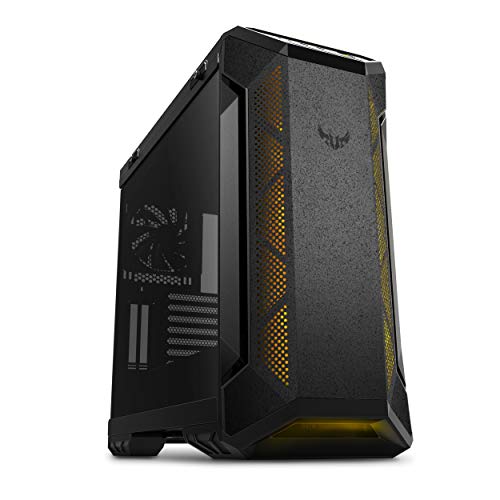
ASUS TUF Gaming E-ATX Full-Tower Case
Best for: E-ATX builders needing transport handles
- Motherboard Support
- E-ATX
- Case Type
- Full-Tower
- Side Panel
- Tempered Glass
- Radiator Support
- 360mm
- Max GPU Length
- 420mm
- Fan Size
- 120mm, 140mm
View on Amazon: ASUS TUF Gaming E-ATX Full-Tower Case Affiliate link
The ASUS TUF GT501 is a full-tower case supporting E-ATX motherboards. It includes three 120mm RGB fans and one 140mm rear PWM fan. You get up to seven fan mounting points and support for 360mm radiators. The chassis features a smoked tempered glass side panel. It also includes woven-cotton carry handles for transport.
Pros
- Supports E-ATX motherboards in a full-tower chassis
- Includes three 120mm RGB fans and one 140mm rear PWM fan
- Supports 360mm radiators on top or front
- Features smoked tempered glass side panel
- Includes woven-cotton carry handles
Cons
- Heavier build at 26.2 pounds
- Only one rear fan included
- No mention of front panel USB-C connectivity
Good fit if
- You need space for large E-ATX motherboards
- You want pre-installed RGB lighting
- You plan to move the case often
Skip if
- You prefer a smaller mid-tower form factor
- You want a lighter case for easy transport
- You need extensive front panel connectivity
Verdict: ASUS TUF GT501 E-ATX Full-Tower suits builders needing maximum motherboard support and transport handles. It fits those prioritizing E-ATX compatibility and included RGB fans.
Specifications side by side
| Spec | Corsair 7000D Airflow Full-Tower Case | ASUS TUF Gaming E-ATX Full-Tower Case |
|---|---|---|
| Motherboard Support | ATX | E-ATX |
| Case Type | Full-Tower | Full-Tower |
| Side Panel | not stated | Tempered Glass |
| Included Fans | 3x 140mm | not stated |
| Radiator Support | 420mm | 360mm |
| Max GPU Length | not stated | 420mm |
| Tower Size | Full-Tower | Full-Tower |
| Fan Size | 140mm | 120mm, 140mm |
| Use | not stated | Gaming |
| Lighting | not stated | RGB |
| Compatible Device | not stated | Radiator |
| Dimensions | 21.7 × 9.76 × 23.6 inches | 215 × 98.8 × 217 inches |
| Weight | 41.2 pounds | 26.2 pounds |
| Size | 7000 Series | EATX |
| Color | Black | GT501|Grey |
| Model | CC-9011218-WW | GT501/GRY/WITH HANDLE |
Frequently asked questions
Which Corsair or ASUS case is best for extreme cooling?
The Corsair 7000D Airflow Full-Tower is ideal for builders prioritizing massive cooling capacity. It supports 140mm fans and is designed for extensive radiator support. This makes it suitable for high-end components that generate significant heat. You get robust airflow management in a large chassis.
Does the ASUS TUF Gaming case support E-ATX motherboards?
Yes, the ASUS TUF Gaming E-ATX Full-Tower Case supports E-ATX motherboards. This larger format accommodates more expansion slots and features than standard ATX boards. It is designed for builders who need maximum motherboard compatibility and include pre-drilled holes for water pump mounting.
How heavy is the Corsair 7000D Airflow case?
The Corsair 7000D Airflow weighs 41.2 pounds. Its dimensions are 9.76 inches wide, 23.6 inches high, and 21.7 inches long. This substantial weight reflects its full-tower construction and metal build quality. It is a stationary case designed for stability rather than frequent transport.
Is the ASUS TUF GT501 easy to transport?
The ASUS TUF Gaming GT501 includes transport handles for easier movement. It weighs 26.2 pounds, which is lighter than the Corsair option. Its dimensions are 98.8 inches wide, 217 inches high, and 215 inches long. The handles make it convenient for builders who need to move their rig.
What motherboard sizes does the Corsair 7000D support?
The Corsair 7000D Airflow supports ATX motherboards. This is a common form factor that fits most mid-range to high-end builds. It does not list E-ATX support in its primary attributes. It is best for standard ATX builders who need extensive cable management and cooling.
Which case is better for vertical GPU mounting?
The ASUS TUF Gaming GT501 offers vertical GPU expansion slots. This feature allows you to mount your graphics card vertically for display purposes. The Corsair 7000D focuses on airflow and cable management instead. Choose the ASUS model if vertical mounting is a priority for your build.