ATX or E-Atx PC Cases? Compared by Specs
As an Amazon Associate we earn from qualifying purchases. Links on this page are affiliate links.
Choosing between an ATX vs E-ATX PC case depends on your motherboard size and cooling needs. Both the Thermaltake Versa H21 and ASUS TUF Gaming GT501 are designed for desktop builds, but they serve different form factors. The Thermaltake supports standard ATX boards in a mid-tower chassis. The ASUS model accommodates larger E-ATX motherboards in a full-tower design. You should pick based on your specific hardware requirements and space constraints.
Key differences
| Aspect | Thermaltake Versa H21 ATX Mid Tower | ASUS TUF Gaming E-ATX Full-Tower Case |
|---|---|---|
| Motherboard Support | ATX | E-ATX |
| Tower Size | Mid Tower | Full Tower |
| Side Panel | not listed | Tempered Glass |
| Radiator Support | not listed | 360mm |
| Weight | 9.3 pounds | 26.2 pounds |
Which one should you choose?
Choose Thermaltake Versa H21 ATX Mid Tower if
- You are building with a standard ATX motherboard and want a compact mid-tower chassis.
- You prefer a lighter case that is easier to move and fits in smaller spaces.
Choose ASUS TUF Gaming E-ATX Full-Tower Case if
- You need to install an E-ATX motherboard or a large custom liquid cooling loop.
- You want a full-tower case with tempered glass visibility and pre-installed fans.
Verdict: The Thermaltake Versa H21 is the practical choice for standard ATX builds where space and weight matter. The ASUS TUF Gaming GT501 suits enthusiasts requiring E-ATX support and advanced cooling options. Your decision should hinge on your motherboard size and desired case dimensions.
ATX vs E-ATX Case Specs
Motherboard Support
The Thermaltake Versa H21 is designed specifically for standard ATX motherboards. This limits you to boards that fit within the ATX form factor dimensions. The ASUS TUF Gaming GT501 supports E-ATX motherboards. This allows you to install larger boards, including those with extended PCBs or additional PCIe slots. If your build requires an E-ATX board, the Thermaltake will not accommodate it. The ASUS provides the necessary space for these larger components. This is the primary distinction between the two cases. Your choice depends entirely on the motherboard size you plan to use.
Tower Size
The Thermaltake Versa H21 is classified as a Mid Tower. This size is generally more compact and fits well on most desks or under them. The ASUS TUF Gaming GT501 is a Full-Tower. Full-tower cases are significantly larger and heavier. This size offers more internal volume for extensive builds and multiple components. The Mid Tower design of the Thermaltake is easier to fit in smaller spaces. The Full-Tower ASUS requires more room on your floor or desk. Consider your available space and whether you need the extra volume of a Full-Tower chassis.
Radiator Support
The ASUS TUF Gaming GT501 explicitly supports radiators up to 360mm. It also includes pre-drilled holes for water pump and reservoir mounting. This makes it ready for custom liquid cooling loops. The Thermaltake Versa H21 data does not list specific radiator size support. While it mentions a liquid cooling system is supported, exact dimensions are not provided. If you plan to use large radiators for high-performance cooling, the ASUS has clear specifications. The Thermaltake may support smaller radiators, but the lack of detail makes the ASUS the safer choice for advanced cooling.
Side Panel
The ASUS TUF Gaming GT501 features a 4mm-thick smoked, tempered-glass full view side panel. This allows you to see the internal components clearly. The Thermaltake Versa H21 data does not specify the material of its side panel. It mentions a perforated metal mesh front and top panel for ventilation, but the side material is unknown. If you want to showcase your build through glass, the ASUS is the clear option. The Thermaltake may have a metal or plastic side panel, but this is not confirmed in the provided specifications.
Connectivity
The Thermaltake Versa H21 includes a SuperSpeed USB 3.0 port and a standard USB 2.0 port. It also provides HD microphone and headset jacks on the top panel. This offers direct access for peripherals and audio devices. The ASUS TUF Gaming GT501 data does not list specific I/O ports or connectivity options. While it likely includes USB ports, the exact types and quantities are not provided. The Thermaltake gives you known connectivity features out of the box. The ASUS connectivity details are missing from the data, so the Thermaltake has the advantage here.
Which ATX Or E-ATX Case Fits You
Users needing compact ATX builds with tool-free assembly
The Thermaltake Versa H21 supports standard ATX motherboards in a mid-tower form factor. Its tool-free installation simplifies the build process. The perforated mesh panels and raised feet improve airflow. This compact chassis is ideal for standard components without the bulk of a full-tower design.
Builders requiring E-ATX support and extensive cooling options
The ASUS TUF Gaming GT501 accommodates E-ATX motherboards in a full-tower chassis. It includes pre-drilled holes for liquid cooling and supports large radiators. The vertical GPU slot and multiple fan mounts provide flexibility. This case suits systems needing maximum expansion and thermal headroom.
Users prioritizing portability and sturdy construction for transport
The ASUS TUF Gaming GT501 features woven-cotton carry handles designed for safe transport of heavy systems. It supports builds up to 65lbs. The metal chassis and tempered glass side panel offer durability. This full-tower case is practical for users who move their high-end PC setups frequently.
Quick picks
| # | Product | Best for | Price |
|---|---|---|---|
| 1 | Thermaltake Versa H21 ATX Mid Tower | Standard ATX builds with good airflow | Check price of Thermaltake Versa H21 ATX Mid Tower on Amazon |
| 2 | ASUS TUF Gaming E-ATX Full-Tower Case | E-ATX builds with large liquid cooling setups | Check price of ASUS TUF Gaming E-ATX Full-Tower Case on Amazon |
The products compared
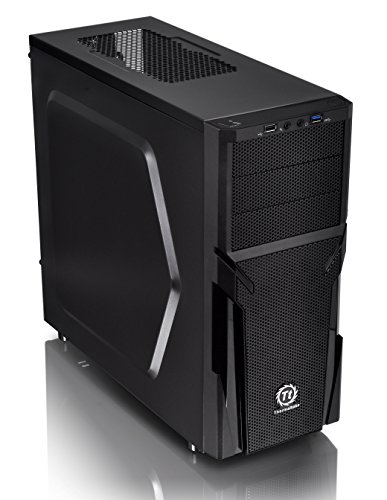
Thermaltake Versa H21 ATX Mid Tower
Best for: Standard ATX builds with good airflow
- Motherboard Support
- ATX (what this guide is about)
- Case Type
- Mid Tower
- Dimensions
- 18.7 × 8.2 × 16.9 inches
- Weight
- 9.3 pounds
View on Amazon: Thermaltake Versa H21 ATX Mid Tower Affiliate link
The Thermaltake Versa H21 is a black ATX mid-tower chassis designed for standard motherboard support. It features a perforated metal mesh front and top panel to maximize airflow and heat dissipation. The case includes tool-free installation and optimized ventilation with heighted foot stands. You get direct access to a USB 3.0 port, USB 2.0 port, and audio jacks. It supports long graphics cards and liquid cooling systems.
Pros
- Perforated mesh front and top panels for rapid air intake
- Tool-free installation for easier assembly
- USB 3.0 and USB 2.0 ports with audio jacks
- Supports ATX motherboards and long graphics cards
Cons
- Limited to ATX motherboard support, excluding E-ATX boards
- Mid-tower size may restrict extreme cooling setups
- No mention of included case fans
Good fit if
- You need a case for standard ATX motherboards
- You want tool-free installation for quick builds
- You prioritize front panel I/O accessibility
Skip if
- You require E-ATX motherboard support
- You need a full-tower chassis for multiple GPUs
- You prefer a case with pre-installed fans
Verdict: Thermaltake Versa H21 ATX Mid Tower fits users building with standard ATX boards who value easy assembly and solid airflow. It is not suitable for those needing E-ATX support or larger chassis sizes.
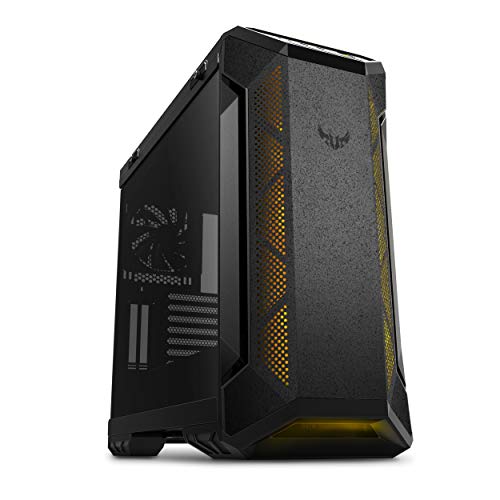
ASUS TUF Gaming E-ATX Full-Tower Case
Best for: E-ATX builds with large liquid cooling setups
- Motherboard Support
- E-ATX (what this guide is about)
- Case Type
- Full-Tower
- Side Panel
- Tempered Glass
- Radiator Support
- 360mm
- Max GPU Length
- 420mm
- Fan Size
- 120mm, 140mm
View on Amazon: ASUS TUF Gaming E-ATX Full-Tower Case Affiliate link
This full-tower case supports E-ATX motherboards and features a tempered glass side panel. It includes three 120mm RGB fans and one 140mm rear PWM fan. The chassis allows for up to seven optional fan mounts and supports 360mm radiators. You get vertical GPU expansion plus seven traditional slots. Woven-cotton handles enable transport for units up to 65 lbs.
Pros
- Supports E-ATX motherboards
- Includes three 120mm RGB fans and one 140mm rear PWM fan
- Supports 360mm top or front radiators
- Vertical GPU expansion slot plus seven traditional slots
- Woven-cotton carry handles for transport
Cons
- Heavy at 26.2 pounds
- Large full-tower footprint
- No app control mentioned
Good fit if
- You need E-ATX motherboard support
- You want extensive fan mounting options
- You plan to use large liquid cooling radiators
Skip if
- You prefer a compact mid-tower case
- You want to avoid heavy components
- You only need ATX motherboard support
Verdict: ASUS TUF Gaming GT501 E-ATX Full-Tower suits builders needing E-ATX support and robust cooling options. Its size and weight make it ideal for stationary high-end builds.
Specifications side by side
| Spec | Thermaltake Versa H21 ATX Mid Tower | ASUS TUF Gaming E-ATX Full-Tower Case |
|---|---|---|
| Motherboard Support | ATX | E-ATX |
| Case Type | Mid Tower | Full-Tower |
| Side Panel | not stated | Tempered Glass |
| Radiator Support | not stated | 360mm |
| Max GPU Length | not stated | 420mm |
| Tower Size | Mid-Tower | Full-Tower |
| Fan Size | not stated | 120mm, 140mm |
| Use | not stated | Gaming |
| Lighting | not stated | RGB |
| Compatible Device | not stated | Radiator |
| Dimensions | 18.7 × 8.2 × 16.9 inches | 215 × 98.8 × 217 inches |
| Weight | 9.3 pounds | 26.2 pounds |
| Size | H21 | EATX |
| Color | Black | GT501|Grey |
| Model | CA-1B2-00M1NN-00 | GT501/GRY/WITH HANDLE |
Frequently asked questions
Can an ATX case fit an E-ATX motherboard?
No, an ATX case cannot fit an E-ATX motherboard. The Thermaltake Versa H21 supports only standard ATX boards. Its internal dimensions are sized for that specific form factor. You must choose a case with explicit E-ATX support, like the ASUS TUF Gaming GT501, if your board exceeds ATX dimensions.
What is the physical size difference between ATX and E-ATX cases?
E-ATX cases are significantly larger to accommodate bigger motherboards. The Thermaltake Versa H21 is a mid-tower measuring 16.9 inches in height. The ASUS TUF Gaming GT501 is a full-tower with a height of 217 inches. This substantial size difference impacts desk space and portability for your build.
Is E-ATX better for gaming builds?
E-ATX cases are ideal for high-end gaming setups requiring extensive cooling. The ASUS TUF Gaming GT501 is designed for E-ATX builds with large liquid cooling setups. Its full-tower design allows for more airflow and radiator space than standard mid-tower ATX cases like the Thermaltake Versa H21.
Which case is better for standard ATX builds?
The Thermaltake Versa H21 is the better choice for standard ATX builds. It fits users who value easy assembly and solid airflow within a mid-tower footprint. Its 18.7-inch length and 8.2-inch width provide ample room for standard components without the bulk of a full-tower chassis.
Do E-ATX cases require more desk space?
Yes, E-ATX cases typically require significantly more desk space. The ASUS TUF Gaming GT501 weighs 26.2 pounds and measures 215 inches in length. This makes it ideal for stationary high-end builds rather than portable setups. You must ensure your desk can support its large dimensions and weight.
Can I use an E-ATX motherboard in a mid-tower case?
You generally cannot use an E-ATX motherboard in a standard mid-tower case. The Thermaltake Versa H21 is a mid-tower limited to ATX support. If you need E-ATX compatibility, you must select a full-tower case like the ASUS TUF Gaming GT501, which is explicitly designed for larger motherboards.