Motherboard Support in PC Cases: What It Is and Is It Worth It?
As an Amazon Associate we earn from qualifying purchases. Links on this page are affiliate links.
Understanding Motherboard Support Standards
Motherboard support explained defines the physical compatibility between your case and your main circuit board. It determines which form factors fit inside the chassis. You must match the case capacity to your board size. This spec is the foundation of your build. It ensures your components sit securely and align with rear I/O ports.
The industry uses four primary standards. ATX is the most common standard for mid-towers. It measures 12 by 9.6 inches. This size offers ample space for RAM, graphics cards, and cooling solutions. Most builders choose this format for general use.
E-ATX is a larger variant. It often measures up to 13 by 12 inches. High-end workstations and gaming rigs use this size. It allows for more PCIe slots and larger VRMs. You need a case with expanded mounting holes for this board. Check the case dimensions carefully. Not all ATX cases fit E-ATX boards.
Micro-ATX boards are smaller. They measure 9.6 by 9.6 inches. They retain the core features of ATX but save space. You can fit them in any case that supports ATX. This provides flexibility for compact builds without sacrificing too much performance.
Mini-ITX is the smallest standard. It measures 6.7 by 6.7 inches. These boards are ideal for small form factor cases. They limit the number of expansion slots. You must plan your cooling and storage carefully. Space is tight in these builds.
When shopping, look for the listed support formats. A case listing "ATX" usually includes Micro-ATX and Mini-ITX support. However, a case listing only "Mini-ATX" will not fit larger boards. Always verify the maximum supported size. This prevents you from buying a case that cannot hold your motherboard. Proper support ensures a clean and stable installation.
Choosing Your Motherboard Form Factor
Micro-ATX
Micro-ATX boards measure 9.6 by 9.6 inches. They offer fewer expansion slots than larger boards. This makes them ideal for compact builds. You save space on the desk or floor. The Cooler Master N200 Mesh supports this size. It fits users who need basic performance in a small footprint. Airflow remains strong in these smaller enclosures. You sacrifice some PCIe slots for reduced dimensions. This is a practical choice for budget or office PCs. The trade-off is limited upgrade paths for multiple graphics cards. You fit more into less room.
Mini-ITX
Mini-ITX is the smallest standard at 6.7 by 6.7 inches. It supports only one PCIe slot. This limits you to a single GPU. The SilverStone SG13B handles this tiny form factor. It suits builders who prioritize portability or minimalism. You get a very small chassis. Assembly can be tighter due to cable management space. You must check GPU length and cooler height carefully. Power supply compatibility varies in small cases. This option is best for HTPCs or travel rigs. The main trade-off is significant expansion limitation. You gain extreme compactness but lose flexibility for future upgrades.
ATX
ATX is the standard mid-tower size at 12 by 9.6 inches. It offers a balance of space and features. Most cases support this format. The Thermaltake Versa H21 is a classic ATX example. It provides room for standard components and decent airflow. You get four PCIe slots for expansion cards. This fits the majority of mainstream builders. Assembly is straightforward with ample cable routing space. You can install multiple fans and liquid cooling radiators. The trade-off is a larger physical footprint. It takes up more desk or floor space. However, it remains the most versatile and widely supported option.
E-ATX
E-ATX boards are wider than standard ATX, often 12 by 13 inches or more. They support high-end workstations and gaming rigs. The ASUS TUF Gaming E-ATX Full-Tower accommodates these large boards. You get extensive expansion for multiple GPUs and drives. This size suits enthusiasts with heavy cooling needs. The case must be physically larger to fit the board. You may need a full-tower chassis. The trade-off is significant size and weight. It requires a dedicated desk or floor space. Cable management can be complex in dense layouts. This is for builders who need maximum connectivity and cooling capacity.
Is Full Motherboard Support Worth It
Who needs it
You need this spec if you plan to build a high-performance system with a large graphics card and multiple storage drives. Full support for ATX and E-ATX boards gives you room for extra PCIe slots. This matters for workstations or gaming rigs that require extensive expansion. If you want to upgrade your CPU cooler or add specialized cards later, the extra space in an E-ATX case helps. It also allows for better airflow management around the motherboard. You benefit from the flexibility to swap components without changing the entire chassis. This is crucial for builders who value long-term upgradeability. You avoid the frustration of cramped interiors. The ability to fit larger boards means you are not limited by tight constraints. This spec ensures your case grows with your needs. It is essential for those who prioritize maximum compatibility and future-proofing in their build.
Who can skip it
You can skip detailed motherboard support checks if you are building a small form factor PC. If you only need Micro-ITX or Micro-ATX compatibility, larger cases are unnecessary. You save money and desk space by choosing a compact option. Focus on airflow and cable management instead. These factors matter more for small builds than raw motherboard size. You do not need extra expansion slots if you use a single graphics card. Prioritize cooling efficiency and noise reduction. A smaller case often moves air faster. You avoid paying for unused space. Your priority should be fitting the components you actually plan to use. Do not buy a large case just for potential future parts you may never install. Keep your build simple and efficient. Look for cases that match your current hardware exactly. This approach reduces clutter and simplifies the assembly process. You get a cleaner setup without wasted volume.
Case Specs Glossary
Motherboard Support
The list of form factors a case holds, such as ATX or ITX. It dictates which main circuit boards fit physically inside the chassis without obstruction.
Tower Size
The physical dimensions of the case, including height, width, and depth. This determines how much desk or floor space the system occupies during operation.
Fan Size
The diameter of the cooling fans, commonly 120mm or 140mm. Larger fans move more air at lower speeds, reducing noise while maintaining thermal performance.
Side Panel
The cover on the case side, often made of tempered glass or mesh. It affects visibility of internal components and influences airflow dynamics into the chassis.
Use
The intended purpose of the case, such as gaming, workstations, or compact builds. This classification helps you select a design that matches your specific performance needs.
Lighting
LED strips or fans that illuminate the interior. This feature is purely aesthetic and does not impact cooling efficiency or the functional performance of the hardware.
Connectivity
The ports available on the front panel, like USB-C or audio jacks. These allow direct access to peripherals without reaching behind the computer tower.
Radiator Support
The ability to mount liquid cooling radiators in specific locations. This spec ensures you can install AIO coolers or custom loops for enhanced thermal management.
Quick picks
| # | Product | Best for | Price |
|---|---|---|---|
| 1 | Thermaltake Versa H21 ATX Mid Tower | Standard ATX builds with basic airflow needs | Check price of Thermaltake Versa H21 ATX Mid Tower on Amazon |
| 2 | ASUS TUF Gaming E-ATX Full-Tower Case | large E-ATX builds with custom cooling | Check price of ASUS TUF Gaming E-ATX Full-Tower Case on Amazon |
| 3 | Cooler Master N200 Mesh Mini-Tower | compact micro-atx builds with mesh airflow | Check price of Cooler Master N200 Mesh Mini-Tower on Amazon |
| 4 | SilverStone Small Form Factor Mini-ITX Case | compact Mini-ITX builds with short GPUs | Check price of SilverStone Small Form Factor Mini-ITX Case on Amazon |
| 5 | be quiet! Pure Base 600 ATX Mid Tower | ATX builders prioritizing quiet cooling | Check price of be quiet! Pure Base 600 ATX Mid Tower on Amazon |
| 6 | ASUS ROG Strix Helios RGB Mid-Tower Case | E-ATX builds with multiple GPUs | Check price of ASUS ROG Strix Helios RGB Mid-Tower Case on Amazon |
Our 6 picks
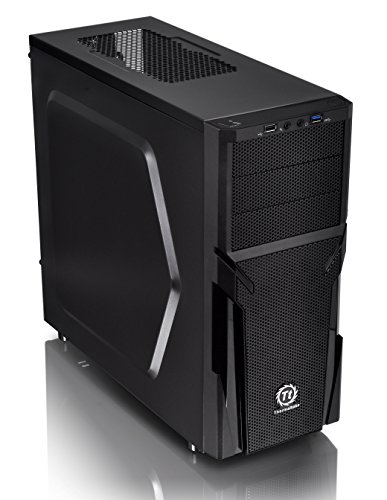
Thermaltake Versa H21 ATX Mid Tower
Best for: Standard ATX builds with basic airflow needs
- Motherboard Support
- ATX (what this guide is about)
- Case Type
- Mid Tower
- Dimensions
- 18.7 × 8.2 × 16.9 inches
- Weight
- 9.3 pounds
View on Amazon: Thermaltake Versa H21 ATX Mid Tower Affiliate link
The Thermaltake Versa H21 is a black ATX mid tower chassis designed for straightforward builds. It features a perforated metal mesh front and top panel to support rapid air intake and heat dissipation. The case includes tool-free installation and pre-mounting holes for standard ATX motherboards and long graphics cards. You get direct access to USB 3.0, USB 2.0, and audio jacks on the top I/O panel. This chassis suits users who prioritize basic ventilation and easy assembly for standard ATX systems.
Pros
- Perforated mesh front and top panel for optimized ventilation
- Tool-free installation design for easier assembly
- Top I/O panel includes USB 3.0 and USB 2.0 ports
- Supports standard ATX motherboards and long graphics cards
Cons
- Limited to ATX motherboard support, excluding E-ATX or Mini-ITX
- Only one pre-installed fan location implied by mesh design
- No mention of included case fans in specifications
Good fit if
- You need a budget-friendly case for a standard ATX build
- You prefer tool-free installation for quick assembly
- You want direct top-panel access to USB and audio ports
Skip if
- You require support for E-ATX or Mini-ITX motherboards
- You need pre-installed case fans for immediate airflow
- You are building a high-end enthusiast system requiring extensive cable management options
Verdict: Thermaltake Versa H21 ATX Mid Tower is a functional entry-level case for standard ATX builds. It fits users who want basic ventilation and simple assembly without extra frills.
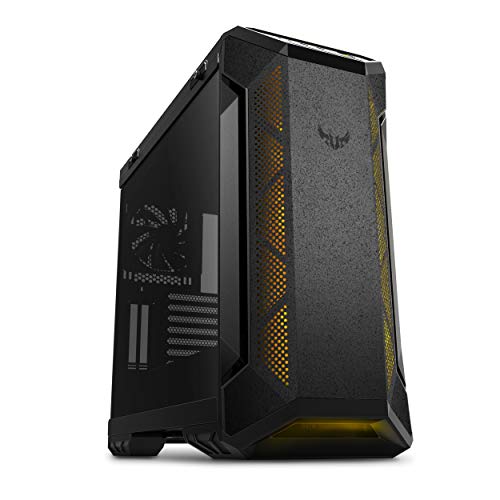
ASUS TUF Gaming E-ATX Full-Tower Case
Best for: large E-ATX builds with custom cooling
- Motherboard Support
- E-ATX (what this guide is about)
- Case Type
- Full-Tower
- Side Panel
- Tempered Glass
- Radiator Support
- 360mm
- Max GPU Length
- 420mm
- Fan Size
- 120mm, 140mm
View on Amazon: ASUS TUF Gaming E-ATX Full-Tower Case Affiliate link
The ASUS TUF GT501 is an E-ATX full-tower case designed for large builds. It supports motherboards up to E-ATX size and includes a tempered glass side panel. The chassis comes with three 120mm RGB fans and one 140mm rear fan. It features pre-drilled holes for custom liquid cooling and supports radiators up to 360mm. This case suits users who need space for extensive hardware and high-end cooling setups.
Pros
- Supports E-ATX motherboards for maximum component compatibility
- Includes four pre-installed fans for immediate airflow
- Pre-drilled holes support custom liquid cooling installations
- Tempered glass side panel offers clear component visibility
- Vertical GPU slot adds flexible mounting options
Cons
- Full-tower size requires significant desk or floor space
- Heavy weight of 26.2 pounds makes transport difficult
- Specs list dimensions in inches, which is non-standard for case sizes
Good fit if
- You are building a high-end PC with an E-ATX motherboard
- You plan to install custom liquid cooling loops
- You need vertical GPU mounting for cable management
Skip if
- You prefer a compact Mini-ITX or Micro-ATX build
- You have limited space for a large full-tower chassis
- You want a lighter case that is easy to move
Verdict: The ASUS TUF GT501 E-ATX Full-Tower is a spacious option for builders who need room for large motherboards and custom cooling. It fits users who prioritize component visibility and extensive fan support over portability.

Cooler Master N200 Mesh Mini-Tower
Best for: compact micro-atx builds with mesh airflow
- Motherboard Support
- Micro-ATX (what this guide is about)
- Case Type
- Mini Tower
- Radiator Support
- 240mm
- Max GPU Length
- 355mm (14 inches)
- Dimensions
- 17.5 × 7.9 × 14.9 inches
- Weight
- 9.5 pounds
View on Amazon: Cooler Master N200 Mesh Mini-Tower Affiliate link
The Cooler Master N200 is a micro-atx mini tower with a mesh front panel. It supports up to three 3.5-inch drives and four 2.5-inch ssds. The case fits a 240mm radiator and graphics cards up to 355mm long. It also accepts cpu air coolers up to 160mm tall. You get a removable dust filter for easy maintenance. This compact build suits small spaces.
Pros
- Supports micro-atx and mini-itx motherboards
- Full mesh front panel for airflow
- Holds up to three 3.5-inch hard drives
- Accepts 240mm liquid cooling radiators
- Removable dust filter under the power supply
Cons
- Limited to micro-atx and mini-itx boards
- No support for full atx or e-atx motherboards
- Smaller internal volume than mid-tower options
Good fit if
- You need a compact micro-atx case
- You want a mesh front for cooling
- You plan to use a 240mm radiator
Skip if
- You require full atx motherboard support
- You need e-atx compatibility
- You want a full tower chassis
Verdict: The Cooler Master N200 Mini Tower fits users who need a compact micro-atx build with strong airflow. It is ideal for small spaces where full atx cases do not fit.

SilverStone Small Form Factor Mini-ITX Case
Best for: compact Mini-ITX builds with short GPUs
- Motherboard Support
- Mini-ITX (what this guide is about)
- Case Type
- Small Form Factor
- Radiator Support
- 120mm, 140mm
- Max GPU Length
- 10.5 inches
- Dimensions
- 14 × 12 × 10 inches
- Weight
- 6 pounds
View on Amazon: SilverStone Small Form Factor Mini-ITX Case Affiliate link
This SilverStone case supports Mini-DTX and Mini-ITX motherboards with an ATX power supply. It measures 14 by 12 by 10 inches and weighs 6 pounds. The chassis allows GPUs up to 10.5 inches long. You can install 120mm or 140mm single-fan liquid coolers. It includes drive bays for 2.5-inch and 3.5-inch storage. The elevated standoff protects back-side components.
Pros
- Supports Mini-DTX and Mini-ITX motherboards
- Compatible with standard ATX power supplies
- Accepts 120mm or 140mm single-fan AIO coolers
- Includes bays for 2.5-inch and 3.5-inch drives
Cons
- Maximum GPU length is limited to 10.5 inches
- Only supports single-fan liquid coolers, not dual-fan radiators
- Faux aluminum front panel may not match all aesthetics
Good fit if
- You are building a compact Mini-ITX or Mini-DTX system
- You need a case that accepts standard ATX power supplies
- You plan to use a 120mm or 140mm single-fan liquid cooler
Skip if
- You require support for larger ATX or E-ATX motherboards
- You need to install GPUs longer than 10.5 inches
- You prefer a dual-fan radiator setup for better cooling
Verdict: SilverStone SG13B Mini-ITX Case is a compact option for small builds using Mini-ITX or Mini-DTX boards. It fits users who need ATX PSU compatibility and have short GPUs or single-fan coolers.

be quiet! Pure Base 600 ATX Mid Tower
Best for: ATX builders prioritizing quiet cooling
- Motherboard Support
- ATX (what this guide is about)
- Case Type
- Midi Tower
- Included Fans
- 2x be quiet! Pure Wings 2
- Radiator Support
- Up to 360mm
- Use
- Gaming
- Dimensions
- 20.4 × 22.4 × 11.3 inches
View on Amazon: be quiet! Pure Base 600 ATX Mid Tower Affiliate link
The be quiet! Pure Base 600 is an ATX mid-tower case designed for quiet operation and cooling flexibility. It includes two pre-installed Pure Wings 2 fans and supports radiators up to 360mm on the front, top, and rear. The adjustable top cover adds ventilation options. This case suits builders who prioritize acoustic performance and water cooling compatibility within a standard ATX footprint.
Pros
- Supports ATX motherboards
- Includes two pre-installed Pure Wings 2 fans
- Accepts radiators up to 360mm on front, top, and rear
- Adjustable top cover for enhanced airflow or radiator mounting
Cons
- Limited to ATX motherboard support, excluding E-ATX boards
- Heavier at 16.4 pounds compared to many mid-towers
- No mention of side window or RGB lighting features
Good fit if
- You need reliable ATX support with strong cooling options
- You prefer pre-installed fans for immediate airflow
- You plan to use large radiators up to 360mm
Skip if
- You require E-ATX motherboard compatibility
- You want a lighter case for frequent moving
- You need side panel glass or RGB features
Verdict: The be quiet! Pure Base 600 ATX Case fits builders who need solid ATX support and flexible water cooling without the bulk of an E-ATX tower.
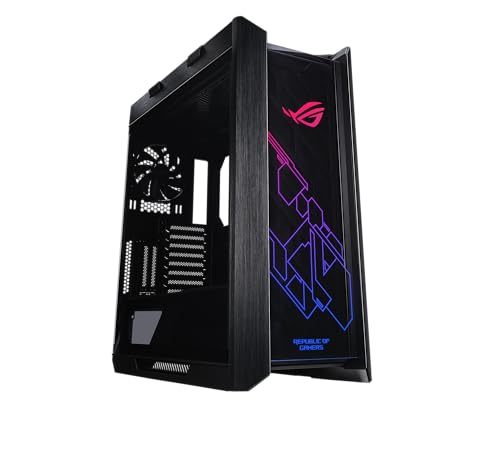
ASUS ROG Strix Helios RGB Mid-Tower Case
Best for: E-ATX builds with multiple GPUs
- Motherboard Support
- E-ATX (what this guide is about)
- Case Type
- Mid-Tower
- Side Panel
- Tempered Glass
- Included Fans
- 4x 140mm
- Radiator Support
- 420mm
- Max GPU Length
- 450mm
View on Amazon: ASUS ROG Strix Helios RGB Mid-Tower Case Affiliate link
This mid-tower chassis supports E-ATX motherboards and features a metal build with tempered glass side panels. It includes four 140mm fans and a built-in hub. You get space for radiators up to 420mm and options for vertical or horizontal GPU mounting. The design includes a pre-run cable management system. It suits builders needing extensive expansion slots and robust cooling for large components.
Pros
- Supports E-ATX motherboards in a mid-tower form factor
- Includes four 140mm fans and a built-in fan hub
- Accepts radiators up to 420mm in length
- Allows up to three horizontally mounted graphics cards
- Features pre-run chassis cables and GPU support brackets
Cons
- Weighs 39.7 pounds, making it heavy to move
- Dimensions are 23.3 inches tall and 22.2 inches deep
- No app or software control mentioned for RGB lighting
Good fit if
- You need an E-ATX motherboard for high-end CPUs
- You plan to use multiple graphics cards
- You want pre-routed cables for easier assembly
Skip if
- You only use Micro-ATX or Mini-ITX boards
- You need a compact case under 20 inches tall
- You prefer a lightweight chassis for frequent moves
Verdict: ASUS ROG Strix Helios E-ATX Mid-Tower fits builders who need room for large motherboards and multiple GPUs. Its heavy build and deep chassis suit stationary gaming rigs with extensive cooling needs.
Specifications side by side
| Spec | Thermaltake Versa H21 ATX Mid Tower | ASUS TUF Gaming E-ATX Full-Tower Case | Cooler Master N200 Mesh Mini-Tower | SilverStone Small Form Factor Mini-ITX Case | be quiet! Pure Base 600 ATX Mid Tower | ASUS ROG Strix Helios RGB Mid-Tower Case |
|---|---|---|---|---|---|---|
| Motherboard Support | ATX | E-ATX | mATX, Mini-ITX | Mini-DTX, Mini-ITX | ATX | EATX |
| Case Type | Mid Tower | Full-Tower | Mini Tower | Small Form Factor | Midi Tower | Mid-Tower |
| Side Panel | not stated | Tempered Glass | not stated | not stated | not stated | Tempered Glass |
| Included Fans | not stated | not stated | not stated | not stated | 2x be quiet! Pure Wings 2 | 4x 140mm |
| Radiator Support | not stated | 360mm | 240mm | 120mm, 140mm | Up to 360mm | 420mm |
| Max GPU Length | not stated | 420mm | 355mm (14 inches) | 10.5 inches | not stated | 450mm |
| Tower Size | Mid-Tower | Full-Tower | Mini-Tower | Small Form Factor | not stated | Mid-Tower |
| Fan Size | not stated | 120mm, 140mm | not stated | not stated | not stated | not stated |
| Use | not stated | Gaming | not stated | not stated | Gaming | Gaming |
| Lighting | not stated | RGB | not stated | not stated | not stated | RGB |
| Compatible Device | not stated | Radiator | not stated | not stated | not stated | Radiator, Graphics Card |
| Dimensions | 18.7 × 8.2 × 16.9 inches | 215 × 98.8 × 217 inches | 17.5 × 7.9 × 14.9 inches | 14 × 12 × 10 inches | 20.4 × 22.4 × 11.3 inches | 22.2 × 9.8 × 23.3 inches |
| Weight | 9.3 pounds | 26.2 pounds | 9.5 pounds | 6 pounds | 16.4 pounds | 39.7 pounds |
| Size | H21 | EATX | N200 | not stated | Black | GX601|Black |
| Color | Black | GT501|Grey | N200 | SG13B-Q-V1 | Black | Helios GX601|Black |
| Model | CA-1B2-00M1NN-00 | GT501/GRY/WITH HANDLE | NSE-200-KKN1 | SG13B-Q | BG021 | 90DC0020-B39000 |
Frequently asked questions
Can an ATX case fit a Micro-ATX motherboard?
Yes, most ATX cases support smaller form factors like Micro-ATX and Mini-ITX. The mounting holes align, allowing you to secure the board securely. This flexibility lets you upgrade from a compact build to a larger one later. You retain the ability to use standard ATX expansion slots if needed.
What is the difference between ATX and E-ATX support?
ATX boards measure 12 by 9.6 inches, while E-ATX boards are wider, often up to 13 by 12 inches. Cases with E-ATX support provide extra width for additional PCIe slots. This is crucial for workstations needing multiple GPUs or specialized expansion cards. Standard ATX cases may not accommodate the wider E-ATX footprint.
Do Mini-ITX cases require special power supplies?
Mini-ITX cases often support standard ATX power supplies, but some small form factor designs require SFX units. You must check the case specifications for PSU compatibility. The SilverStone SG13B supports ATX PSUs, offering flexibility. Verify the internal clearance to ensure your chosen power supply fits without obstructing other components.
How does tower size affect motherboard support?
Tower size determines the maximum motherboard dimensions the chassis can hold. Full-tower cases support E-ATX boards and offer extensive cooling options. Mid-tower cases typically support ATX and smaller boards. Mini-towers are restricted to Micro-ATX or Mini-ITX. Your choice depends on the board size you plan to install and the space available on your desk.
Is E-ATX support necessary for gaming PCs?
E-ATX support is beneficial if you plan to use multiple graphics cards or require extra PCIe slots for capture cards. It provides room for large motherboards with enhanced VRMs. For standard gaming builds, ATX support is usually sufficient. However, E-ATX cases like the ASUS TUF GT501 offer more space for custom cooling loops.
Can I install an ATX board in a Micro-ATX case?
No, you cannot install an ATX board in a Micro-ATX case. The ATX board is physically larger than the mounting area. Micro-ATX cases, like the Cooler Master N200, are designed strictly for 9.6 by 9.6 inch boards. Attempting to force a larger board will result in obstruction and potential damage to the components.