darkFlash vs ASUS: PC Cases Compared by Specs
As an Amazon Associate we earn from qualifying purchases. Links on this page are affiliate links.
This ASUS vs darkFlash PC case comparison looks at two distinct builds for your rig. Both options feature tempered glass side panels and support 360mm radiators for liquid cooling. The main difference lies in their physical scale and motherboard compatibility. The darkFlash model is a mid-tower designed for standard ATX boards, while the ASUS unit is a full-tower that accommodates larger E-ATX motherboards. We will break down these specifications to help you decide which form factor fits your needs.
Key differences
| Aspect | darkFlash ATX Mid-Tower Dual Glass Case | ASUS TUF Gaming E-ATX Full-Tower Case |
|---|---|---|
| Tower Size | Mid-Tower | Full-Tower |
| Motherboard Support | ATX | E-ATX |
| Included Fans | 4x PWM ARGB | 3x 120mm Aura Sync RGB, 1x 140mm rear PWM |
| Connectivity | USB 3.0, Type-C | not listed |
| Special Features | Magnetic dust filters, anti-slip base | Carry handles, vertical GPU slot, pump holes |
Which one should you choose?
Choose darkFlash ATX Mid-Tower Dual Glass Case if
- You need a compact mid-tower case that fits standard ATX motherboards.
- You want USB Type-C connectivity and pre-installed ARGB fans.
- You prefer magnetic dust filters and a smaller footprint.
Choose ASUS TUF Gaming E-ATX Full-Tower Case if
- You require a full-tower chassis for E-ATX motherboards.
- You plan to use custom liquid cooling with pump mounting holes.
- You want built-in carry handles for transporting a heavy case.
Verdict: Choose the darkFlash if you need a standard ATX mid-tower with modern USB-C ports and included ARGB fans. Pick the ASUS TUF GT501 if you require a larger full-tower space for E-ATX boards and custom liquid cooling setups. Both cases provide tempered glass visibility and robust cooling potential for gaming.
ASUS vs darkFlash Case Specs
motherboard support
The ASUS TUF Gaming GT501 supports E-ATX motherboards, offering the largest internal footprint for extensive builds. This allows you to install high-end enthusiast boards with multiple PCIe slots and robust VRM heatsinks. The darkFlash ATX Mid-Tower Case is limited to standard ATX boards. While ATX is sufficient for most gamers, it restricts the use of larger, specialized motherboards. If you plan to use an E-ATX board, the ASUS model is the only viable option. The darkFlash case will physically not accommodate the wider dimensions of E-ATX form factors.
tower size
Physical scale is a major differentiator between these two cases. The ASUS model is classified as a Full-Tower, providing a massive interior volume for extensive cable routing and component spacing. The darkFlash unit is a Mid-Tower, designed for more compact desktops. This size difference affects not just component fit but also airflow dynamics and overall footprint on your desk. The Full-Tower designation of the ASUS case suggests it is built for larger systems, while the Mid-Tower darkFlash is suited for standard ATX builds. You must consider your desk space and component list when choosing between these two distinct form factors.
included fans
Pre-installed cooling is a practical feature for immediate use. The darkFlash case comes with four PWM ARGB fans out of the box. This provides immediate airflow and visual customization without additional purchases. The ASUS TUF Gaming GT501 includes three 120mm Aura Sync RGB fans and one 140mm rear PWM fan, totaling four fans as well. Both cases offer four pre-installed units, giving you a head start on cooling. The darkFlash fans are ARGB, while the ASUS fans are Aura Sync RGB. Both support additional fan mounts for future upgrades, ensuring you can expand your cooling setup later.
connectivity
Front panel I/O options vary between the two designs. The darkFlash case features an upgraded IO panel that includes USB 3.0 ports and a Type-C interface. This Type-C port allows for faster data transfer speeds and modern device compatibility. The product data for the ASUS TUF Gaming GT501 does not list specific front panel ports or connectivity options. While ASUS cases typically include USB ports, the lack of explicit data here means you cannot confirm the presence of a Type-C port or the specific USB standards. If modern high-speed connectivity is a priority, the darkFlash offers documented support.
radiator support
Both cases are designed to handle significant liquid cooling setups. The darkFlash ATX Mid-Tower Case supports radiators up to 360mm in size. The ASUS TUF Gaming GT501 also supports 360mm radiators, with specific mounting points for top or front installation. Additionally, the ASUS model supports a 140mm radiator at the rear and includes pre-drilled holes for water pump and reservoir mounting. This extra flexibility in the ASUS case allows for more complex custom loop configurations. Both cases meet the 360mm requirement, but the ASUS offers more detailed mounting options for advanced builders.
Which PC Case Suits Your Build
Users needing large E-ATX motherboard support
The ASUS TUF Gaming GT501 supports E-ATX motherboards, providing the largest internal footprint for extensive builds. You can install high-end enthusiast boards with multiple PCIe slots and robust VRM heatsinks. This full-tower chassis accommodates larger components that would not fit in the smaller darkFlash mid-tower option.
Builders wanting pre-installed cooling fans
The darkFlash ATX Mid-Tower Case comes with four pre-installed PWM ARGB fans, ensuring optimal airflow and heat dissipation right out of the box. You do not need to purchase additional fans immediately. This setup helps keep your components cool during intense gaming sessions without extra initial hardware costs.
Users prioritizing easy transport and handling
The ASUS TUF Gaming GT501 features ergonomic, woven-cotton carry handles. These enable easy and safe transport for cases weighing up to 65lbs. If you frequently move your PC or need to carry it during events, these handles provide a secure grip that the standard darkFlash case design does not include.
The products compared

darkFlash ATX Mid-Tower Dual Glass Case
Best for: ATX builders wanting RGB visibility
- Case Type
- Mid-Tower
- Side Panel
- Tempered Glass
- Included Fans
- 4x PWM ARGB
- Radiator Support
- 360mm
- Motherboard Support
- ATX
- Use
- Gaming
View on Amazon: darkFlash ATX Mid-Tower Dual Glass Case Affiliate link
This darkFlash DS900 is an ATX mid-tower case featuring a 270-degree panoramic tempered glass side panel. It comes with four pre-installed PWM ARGB fans and supports up to ten fans total, including a 360mm radiator. The high-speed IO panel includes USB 3.0 and Type-C ports. Magnetic dust filters are located at the top and on the panel. It measures 17.1 inches in length and weighs 15 pounds.
Pros
- 270-degree panoramic tempered glass side panel
- Four pre-installed PWM ARGB fans
- Supports up to 10 fans and 360mm radiators
- High-speed IO panel with USB 3.0 and Type-C
Cons
- RGB hub controller is not included
- Mid-tower size limits E-ATX motherboard support
- No app or software control mentioned for ARGB
Good fit if
- You want a clear view of your hardware and RGB lighting
- You need USB 3.0 and Type-C connectivity at the front
- You plan to install a 360mm liquid cooler
Skip if
- You require E-ATX motherboard support
- You want a hub controller included for fan control
- You need a full-tower chassis for maximum expansion
Verdict: The darkFlash DS900 ATX Mid-Tower is a solid choice for builders who prioritize aesthetics and airflow within the ATX form factor. It suits those who want pre-installed RGB fans and modern connectivity without needing E-ATX space.
ASUS TUF Gaming E-ATX Full-Tower Case
Best for: Large E-ATX builds with liquid cooling
- Motherboard Support
- E-ATX
- Case Type
- Full-Tower
- Side Panel
- Tempered Glass
- Radiator Support
- 360mm
- Max GPU Length
- 420mm
- Fan Size
- 120mm, 140mm
View on Amazon: ASUS TUF Gaming E-ATX Full-Tower Case Affiliate link
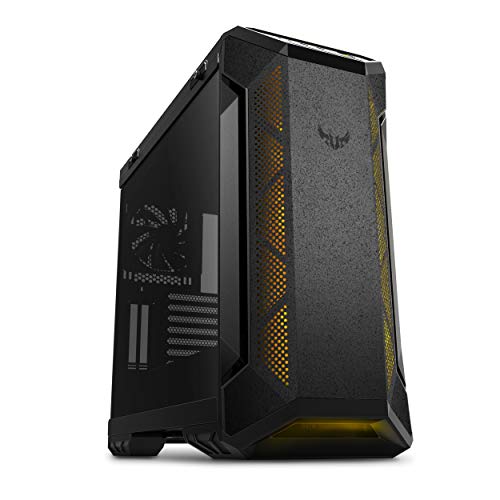
The ASUS TUF GT501 is a full-tower case designed for E-ATX motherboards. It includes three 120mm ARGB fans and one 140mm rear fan for airflow. The chassis supports 360mm radiators for liquid cooling. A tempered glass side panel offers a clear view of components. Woven-cotton handles allow you to carry the case, which weighs 26.2 pounds, up to 65 pounds safely.
Pros
- Supports E-ATX motherboards in a full-tower chassis.
- Pre-installed three 120mm ARGB fans and one 140mm rear PWM fan.
- Supports 360mm radiators for top or front mounting.
- Vertical GPU expansion slot plus seven traditional slots.
- Woven-cotton carry handles for transport.
Cons
- Large full-tower footprint requires ample desk or floor space.
- Heavy at 26.2 pounds, making frequent moves difficult.
- No mention of included front panel USB-C connectivity.
Good fit if
- You need a case for an E-ATX motherboard.
- You want pre-installed ARGB fans for immediate lighting.
- You plan to use a 360mm liquid cooler.
Skip if
- You prefer a compact mid-tower form factor.
- You have limited space for a full-tower chassis.
- You want a lighter case for easy transport.
Verdict: The ASUS TUF GT501 Full-Tower E-ATX Case suits builders needing maximum motherboard support and robust cooling options. It is ideal for large builds that prioritize airflow and aesthetics over portability.
Specifications side by side
| Spec | darkFlash ATX Mid-Tower Dual Glass Case | ASUS TUF Gaming E-ATX Full-Tower Case |
|---|---|---|
| Motherboard Support | not stated | E-ATX |
| Case Type | Mid-Tower | Full-Tower |
| Side Panel | Tempered Glass | Tempered Glass |
| Included Fans | 4x PWM ARGB | not stated |
| Radiator Support | 360mm | 360mm |
| Max GPU Length | not stated | 420mm |
| Tower Size | Mid-Tower | Full-Tower |
| Fan Size | not stated | 120mm, 140mm |
| Use | Gaming | Gaming |
| Lighting | ARGB | RGB |
| Connectivity | Type-C | not stated |
| Compatible Device | Radiator | Radiator |
| Dimensions | 8.6 × 17.8 × 17 inches | 215 × 98.8 × 217 inches |
| Weight | 15 pounds | 26.2 pounds |
| Size | 17.1''L x 8.5''W x 17.8'H | EATX |
| Color | Black | GT501|Grey |
| Model | DS900 | GT501/GRY/WITH HANDLE |
Frequently asked questions
Which case is better for RGB visibility?
The darkFlash DS900 is the better choice for RGB visibility. It features pre-installed ARGB fans and a tempered glass side panel. This design highlights internal lighting components effectively. The ASUS GT501 focuses more on structural durability and airflow for large builds. It does not emphasize aesthetic lighting visibility in the same way as the darkFlash model.
Does the darkFlash case have USB Type-C?
Yes, the darkFlash DS900 includes USB Type-C connectivity. This port allows for faster data transfer and convenient device charging. The ASUS TUF GT501 does not list specific front-panel connectivity options in its published specifications. You should check the rear I/O or assume standard USB 3.0 ports if Type-C is not explicitly mentioned.
Can I install a 360mm radiator in both cases?
Yes, both cases support 360mm radiators. The darkFlash DS900 is compatible with radiators for liquid cooling solutions. The ASUS GT501 also supports large radiators to handle high-end cooling needs. This makes both options suitable for builders who prefer liquid cooling over air cooling for their graphics cards and processors.
Which case is lighter to move?
The darkFlash DS900 is significantly lighter at 15 pounds. The ASUS GT501 weighs 26.2 pounds due to its full-tower construction. If you plan to move your PC frequently, the darkFlash mid-tower is easier to handle. The heavier ASUS case is designed for stationary setups where stability and space are prioritized over portability.
Is the ASUS case suitable for small desks?
No, the ASUS TUF GT501 is not suitable for small desks. It is a full-tower case with a large footprint. The darkFlash DS900 is a mid-tower, which generally occupies less desk space. You should measure your desk depth and width before choosing the ASUS model, as it requires more room for ventilation and component access.
What motherboard size fits in the darkFlash case?
The darkFlash DS900 supports ATX motherboards. It is designed for standard mid-tower builds. It does not support E-ATX boards, which require the larger ASUS GT501. If you are using a standard ATX board, this case provides ample space for components while maintaining a compact footprint compared to full-tower alternatives.