Thermaltake Versa H21 ATX Mid vs Thermaltake Versa H18 Tempered Glass (2026): Key Differences
As an Amazon Associate we earn from qualifying purchases. Links on this page are affiliate links.
You are looking at the thermaltake versa h21 spcc atx vs versa h18 tempered glass. Both cases use black SPCC steel and offer tool-free installation. They also share similar I/O connectivity with USB 3.0 and audio jacks. The main difference lies in their form factor and visibility. The H21 supports standard ATX motherboards in a mid-tower design. The H18 is a compact micro-ATX case featuring a tempered glass side panel for viewing your components.
Key differences
| Aspect | Thermaltake Versa H21 ATX Mid Tower | Thermaltake Versa H18 Tempered Glass Micro-ATX Case |
|---|---|---|
| Motherboard Support | ATX | Micro ATX |
| Tower Size | Mid Tower | Micro-ATX Case |
| Side Panel | Not listed | Tempered Glass |
| Radiator Support | Not listed | Up to 280mm |
| Dimensions | 16.9 x 8.2 x 18.7 inches | 15 x 8.07 x 15.4 inches |
Which one should you choose?
Choose Thermaltake Versa H21 ATX Mid Tower if
- You need space for a standard ATX motherboard and longer graphics cards.
- You prefer a larger chassis with optimized ventilation through perforated panels.
- You want a mid-tower case that accommodates advanced cable management.
Choose Thermaltake Versa H18 Tempered Glass Micro-ATX Case if
- You are building a compact system with a micro-ATX motherboard.
- You want to display your internal components through a tempered glass side panel.
- You need support for AIO liquid cooling solutions up to 280mm.
Verdict: The H21 suits builders who prioritize expandability and standard ATX compatibility. The H18 is the better choice for compact builds where visual appeal and micro-ATX form factors are key. Your decision depends on whether you value motherboard size or aesthetic visibility.
Versa H21 vs H18 Comparison
motherboard support
The Thermaltake Versa H21 supports standard ATX motherboards, giving you room for larger components and more expansion slots. This makes it suitable for builds that need extra PCIe slots or larger CPU coolers. The Versa H18 is limited to Micro ATX boards. This restricts you to smaller form factors with fewer expansion options. If you plan to use a full-size ATX board, the H21 is the only viable choice. The H18 will not fit. This is a clear distinction for anyone building a standard mid-size PC.
tower size
The Versa H21 is a mid-tower case with dimensions of 8.2 inches wide, 16.9 inches high, and 18.7 inches long. It offers more internal volume for cable management and larger components. The Versa H18 is a compact Micro ATX case measuring 8.07 inches wide, 15 inches high, and 15.4 inches long. It is noticeably smaller in height and depth. The H21 provides more breathing room for airflow and component clearance. The H18 saves desk space but offers less room for bulky parts or extensive cable routing.
side panel
The Versa H18 features a tempered glass side panel. This allows you to see the internal components and lighting of your build. The glass adds a premium look to your setup. The Versa H21 uses a perforated metal mesh front and top panel for ventilation. The data does not specify a glass side panel for the H21, implying it uses standard steel or acrylic. If you want to showcase your hardware, the H18 is the better option. The H21 prioritizes airflow over visibility.
radiator support
The Versa H18 supports AIO solutions up to 280mm radiators. This allows for more effective liquid cooling in a compact space. The Versa H21 supports advanced liquid cooling systems, but the specific maximum radiator size is not listed in the provided data. However, its larger mid-tower form factor typically accommodates larger radiators than a Micro ATX case. Without explicit specs for the H21, we cannot confirm if it beats the H18's 280mm limit. The H18 clearly states its 280mm capability.
weight
The Versa H21 weighs 9.3 pounds. The Versa H18 weighs 10.2 pounds. The H21 is lighter, which might make it easier to move or install in a tight space. The H18 is slightly heavier, possibly due to the tempered glass panel or denser construction. The difference is less than one pound. This is a minor factor for most users. It does not significantly impact the decision unless you move your PC frequently. Both cases are manageable for standard desktop setups.
Which Thermaltake Versa Case Fits You
Standard ATX builder needing expansion slots
The Versa H21 supports standard ATX motherboards, giving you more room for larger components and extra PCIe slots. This mid-tower design accommodates longer graphics cards and advanced liquid cooling systems. It is the better choice if you plan to expand your system with additional cards or larger hardware later.
Compact gamer wanting tempered glass side panel
The Versa H18 features a tempered glass side panel for a clean look. It supports Micro ATX boards and includes hidden drive bays for tidy cable management. This compact case fits AIO solutions up to 280mm. It is ideal if you prioritize a smaller footprint and visible internal aesthetics.
User with limited desk space
The Versa H18 is physically smaller, measuring 15 inches in height compared to the H21's 16.9 inches. Its Micro ATX form factor reduces the overall footprint on your desk. If you have a tight workspace, this compact case allows you to fit all necessary components without taking up excessive room.
The products compared
Thermaltake Versa H21 ATX Mid Tower
Best for: Standard ATX builds prioritizing airflow
- Motherboard Support
- ATX
- Case Type
- Mid Tower
- Dimensions
- 18.7 × 8.2 × 16.9 inches
- Weight
- 9.3 pounds
View on Amazon: Thermaltake Versa H21 ATX Mid Tower Affiliate link
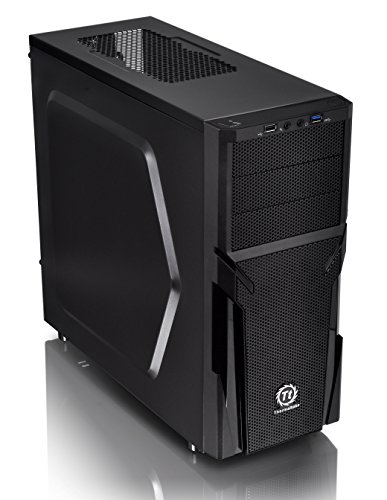
The Thermaltake Versa H21 is a black mid-tower chassis designed for ATX motherboards. It features perforated metal mesh on the front and top panels to maximize airflow. The case includes tool-free installation and pre-mounting holes for CPU coolers and liquid cooling systems. It supports long graphics cards and offers USB 3.0 and USB 2.0 ports on the I/O panel. This build suits you if you need reliable ventilation for standard ATX components.
Pros
- Perforated metal mesh front and top panels for rapid air intake
- Heightened foot-stands enhance bottom airflow
- Tool-free installation for easier assembly
- SuperSpeed USB 3.0 and USB 2.0 ports on the I/O panel
Cons
- Only supports ATX motherboards, excluding smaller Micro ATX builds
- No tempered glass side panel for component visibility
- Built with SPCC steel, which is heavier than aluminum alternatives
Good fit if
- You are building a standard ATX desktop
- You prioritize maximum airflow over aesthetic glass panels
- You want tool-free installation for quick component swaps
Skip if
- You need support for Micro ATX or Mini ITX boards
- You want a tempered glass side panel
- You prefer a lighter aluminum chassis
Verdict: The Thermaltake Versa H21 ATX Mid Tower is a practical choice for builders who prioritize airflow and standard ATX compatibility. It fits you well if you want a sturdy, mesh-fronted case without the weight of glass.

Thermaltake Versa H18 Tempered Glass Micro-ATX Case
Best for: Compact Micro ATX builds with visible internals
- Motherboard Support
- Micro ATX
- Side Panel
- Tempered Glass
- Radiator Support
- 280mm
- Use
- Gaming
- Dimensions
- 15.4 × 8.07 × 15 inches
- Weight
- 10.2 pounds
View on Amazon: Thermaltake Versa H18 Tempered Glass Micro-ATX Case Affiliate link
The Thermaltake Versa H18 is a compact Micro ATX case featuring a tempered glass side panel and a mesh front with a blue LED strip. It supports motherboards up to Micro ATX size and radiators up to 280mm. The chassis includes a full-length PSU cover and hidden drive bays for storage. This design suits users seeking a smaller footprint with visible internal components.
Pros
- Tempered glass side panel for component visibility
- Supports radiators up to 280mm for cooling
- Mesh front panel with built-in blue LED strip
- Full-length PSU cover for clean cable management
Cons
- Limited to Micro ATX motherboards, excluding ATX
- Only one USB 3.0 port on the I/O panel
- Compact dimensions may restrict large GPU installation
Good fit if
- You are building a compact Micro ATX gaming PC
- You want to display components through a glass side panel
- You need support for 280mm AIO cooling solutions
Skip if
- You require a full ATX motherboard form factor
- You need multiple high-speed USB 3.0 ports
- You plan to install graphics cards longer than 280mm
Verdict: Thermaltake Versa H18 Tempered Glass is a compact Micro ATX case that fits users who prioritize a small footprint and visible internals. It is ideal for builders with 280mm cooling needs and Micro ATX boards.
Specifications side by side
| Spec | Thermaltake Versa H21 ATX Mid Tower | Thermaltake Versa H18 Tempered Glass Micro-ATX Case |
|---|---|---|
| Motherboard Support | ATX | Micro ATX |
| Case Type | Mid Tower | not stated |
| Side Panel | not stated | Tempered Glass |
| Radiator Support | not stated | 280mm |
| Tower Size | Mid-Tower | not stated |
| Use | not stated | Gaming |
| Dimensions | 18.7 × 8.2 × 16.9 inches | 15.4 × 8.07 × 15 inches |
| Weight | 9.3 pounds | 10.2 pounds |
| Size | H21 | H18 |
| Color | Black | Black |
| Model | CA-1B2-00M1NN-00 | CA-1J4-00S1WN-01 |
Frequently asked questions
Can the Thermaltake Versa H18 fit an ATX motherboard?
No. The Thermaltake Versa H18 Tempered Glass Micro-ATX Case only supports Micro-ATX motherboards. If you need to install a standard ATX board, you must choose the Versa H21 ATX Mid Tower instead. The H21 is designed specifically for larger ATX form factors and provides the necessary internal space for those boards.
Which case is better for airflow?
The Thermaltake Versa H21 ATX Mid Tower is better for airflow. It features a mesh front panel that allows more air to enter the case compared to solid panels. The Versa H18 has a tempered glass side panel but does not emphasize mesh intake in its design. For cooling efficiency, the H21 is the superior choice.
How much space do I have for graphics cards in the H21?
The Thermaltake Versa H21 ATX Mid Tower measures 18.7 inches in length. This dimension provides ample room for standard and long graphics cards. You can install larger components without worrying about clearance issues. The Versa H18 is shorter at 15.4 inches, which limits the length of compatible GPUs significantly.
Does the Versa H18 have a tempered glass side panel?
Yes. The Thermaltake Versa H18 Tempered Glass Micro-ATX Case includes a tempered glass side panel. This feature allows you to showcase your internal components and RGB lighting. The Versa H21 does not list tempered glass as a feature, focusing instead on a sturdy steel construction with a mesh front for practical airflow.
Which case is lighter?
The Thermaltake Versa H21 ATX Mid Tower is lighter. It weighs 9.3 pounds, while the Versa H18 Tempered Glass Micro-ATX Case weighs 10.2 pounds. The difference is less than one pound, but the H21 is easier to move if you plan to transport your PC frequently. Both cases use steel construction.
Can I use 280mm radiators in the Versa H18?
The product data states the Versa H18 is ideal for builders with 280mm cooling needs. However, it only supports Micro-ATX motherboards. You must ensure your specific chassis version supports the radiator mounting points. The Versa H21 supports ATX boards and offers more vertical space, which may accommodate larger cooling solutions more flexibly.