Lian Li or Apevia? PC Cases Compared in 2026
As an Amazon Associate we earn from qualifying purchases. Links on this page are affiliate links.
When you compare a lian li vs apevia PC case, you are looking at two distinct mid-range options for gaming builds. Both the Lian Li Lancool 205 Mesh and the Apevia Prodigy feature tempered glass side panels and pre-installed RGB fans. The main difference lies in their form factor and motherboard compatibility. The Lian Li supports larger ATX boards, while the Apevia focuses on the more compact Micro-ATX and Mini-ITX sizes. This choice depends on your component scale.
Key differences
| Aspect | Lian Li Lancool 205 Mesh Mid-Tower Case | Apevia Prodigy Micro-ATX Case |
|---|---|---|
| Motherboard Support | ATX, Micro ATX, Mini-ITX | Micro-ATX, Mini-ITX |
| Tower Size | Mid-Tower | Micro-ATX Case |
| Included Fans | 3 ARGB PWM Fans (140mm front, 120mm rear) | 3x RGB Fans |
| Radiator Support | Liquid cooling ready | Up to 120mm on rear |
| Dimensions | 11.6 x 29.2 x 29.2 inches | 15.6 x 16.1 x 7.95 inches |
Which one should you choose?
Choose Lian Li Lancool 205 Mesh Mid-Tower Case if
- You need to fit a standard ATX motherboard
- You prefer larger 140mm front intake fans for airflow
- You want a mid-tower chassis with more internal space
Choose Apevia Prodigy Micro-ATX Case if
- You are building with a Micro-ATX or Mini-ITX board
- You want a smaller footprint that fits on tighter desks
- You need specific clearance for large GPUs up to 350mm
Verdict: Choose the Lian Li if you need the flexibility of full ATX support and larger fans. Pick the Apevia if your build uses smaller motherboards and you want a more compact chassis. Both cases offer tempered glass and RGB lighting for visual appeal.
Lian Li or Apevia? PC Cases Compared in 2026
Motherboard support
The Lian Li Lancool 205 Mesh supports ATX, Micro ATX, and Mini-ITX motherboards. This gives you the flexibility to build with standard ATX boards, which offer more expansion slots and features. The Apevia Prodigy only supports Micro-ATX and Mini-ITX. If you plan to use a full-size ATX board, the Apevia case will not fit it. For builders who prefer the compact nature of Micro-ATX, both cases work. However, the Lian Li offers broader compatibility for larger components and more PCIe slots.
Tower size
The Lian Li Lancool 205 Mesh is a mid-tower chassis. Its dimensions are 11.6 inches in height and 29.2 inches in length. The Apevia Prodigy is also described as a mid-tower in its title, but its physical dimensions are smaller, measuring 15.6 inches in height and 16.1 inches in length. The Lian Li is significantly taller and deeper. This size difference means the Lian Li has more internal volume. You will have more room for cable management and larger components in the Lian Li compared to the more compact Apevia.
Fan size and count
The Lian Li Lancool 205 Mesh comes with three ARGB PWM fans pre-installed. It includes two 140mm fans at the front and one 120mm fan at the rear. The Apevia Prodigy includes three RGB fans, but the specific size is not listed in the provided data. The Lian Li specifies 140mm front fans, which generally move more air than 120mm fans. This suggests better airflow potential at the intake. The Apevia supports up to six 120mm fans total, but the pre-installed count and size are less detailed than the Lian Li.
Radiator support
The Apevia Prodigy supports up to a 120mm radiator on the rear panel. The Lian Li Lancool 205 Mesh is described as liquid cooling ready, but the specific maximum radiator size and mounting positions are not detailed in the provided data. Without explicit specs for the Lian Li, we cannot confirm if it supports larger radiators like 240mm or 280mm. The Apevia clearly supports a 120mm rear radiator. If you need specific radiator sizes, the Apevia offers confirmed rear support, while the Lian Li's capabilities are less defined here.
Connectivity
The Lian Li Lancool 205 Mesh provides two USB 3.0 ports, audio in and out, a power button, and a C/M button on the top I/O panel. The Apevia Prodigy includes USB 3.0 and USB 2.0 ports, along with HD Audio ports. The Lian Li does not list USB 2.0 ports in its features, which might be a limitation if you have older devices. The Apevia includes both USB 3.0 and USB 2.0, offering more versatility for legacy peripherals. The Lian Li adds a dedicated control button for lighting modes.
Which Case Suits Your Build Needs
Standard ATX motherboard users
You need full ATX support. This Lian Li case accommodates ATX, Micro ATX, and Mini-ITX boards. The Apevia Prodigy limits you to Micro ATX and Mini-ITX only. If your build requires the extra expansion slots and features of a standard ATX motherboard, this chassis is the necessary choice for compatibility.
Users wanting maximum fan options
The Apevia Prodigy supports up to six 120mm fans. It also allows for a 120mm radiator on the rear. The Lian Li model comes with three fans but does not list support for additional fan mounts or radiators in its specifications. If you plan to install more cooling hardware than the included three fans, the Apevia offers more physical mounting potential.
Builders needing GPU clearance
This case supports video cards up to 350mm in length. The Lian Li specifications do not list a maximum GPU length. If you are using a very long graphics card, the Apevia provides a confirmed clearance dimension. You can verify your specific card fits within this 350mm limit before purchasing.
The products compared

Lian Li Lancool 205 Mesh Mid-Tower Case
Best for: ATX builders seeking airflow and glass panels
- Motherboard Support
- ATX, Micro ATX, Mini-ITX
- Case Type
- Mid-Tower
- Side Panel
- Tempered Glass
- Use
- Gaming
- Lighting
- ARGB
- Dimensions
- 29.2 × 29.2 × 11.6 inches
View on Amazon: Lian Li Lancool 205 Mesh Mid-Tower Case Affiliate link
This Lian Li mid-tower case combines a mesh front panel with a tempered glass side panel for strong airflow and visibility. It supports ATX, Micro ATX, and Mini-ITX motherboards. The chassis includes three pre-installed ARGB PWM fans and features a top I/O panel with USB 3.0 ports and a Type-C connection. It is designed for gamers who want easy cable management and customizable lighting.
Pros
- Mesh front panel for improved airflow
- Tempered glass side panel
- Supports ATX, Micro ATX, and Mini-ITX
- Includes three ARGB PWM fans
- Top I/O with USB 3.0 and Type-C
Cons
- Lighting control relies on a physical C/M button
- No mention of wireless connectivity for lighting sync
- Heavier build at 15.5 pounds
Good fit if
- You want a mid-tower case with strong airflow
- You need support for ATX or smaller motherboards
- You prefer physical controls for RGB lighting
Skip if
- You require a Mini-ITX specific compact chassis
- You need wireless app-based lighting control
- You prefer a solid front panel over mesh
Verdict: Lian Li LANCOOL 205 MESH RGB Mid-Tower is a practical mid-tower for builders who value airflow and visible components. It suits those who want straightforward physical controls and standard I/O options without complex software integration.
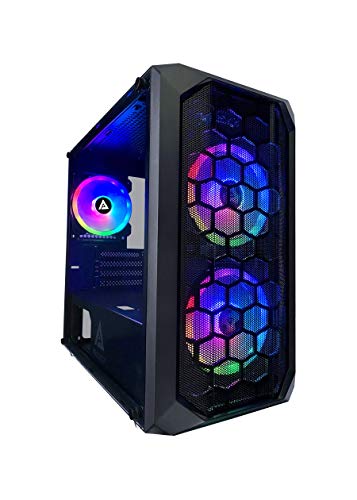
Apevia Prodigy Micro-ATX Case
Best for: Compact Micro-ATX gaming builds with RGB focus
- Motherboard Support
- Micro-ATX, Mini-ITX
- Case Type
- Micro-ATX
- Side Panel
- Tempered Glass
- Included Fans
- 3x RGB
- Radiator Support
- 120mm
- Max GPU Length
- 350mm
View on Amazon: Apevia Prodigy Micro-ATX Case Affiliate link
The Apevia PRODIGY-BK is a black Micro-ATX case featuring a tempered glass side panel and mesh front. It includes three pre-installed RGB fans and supports graphics cards up to 350mm long and CPU coolers up to 165mm high. You get customizable lighting via a physical button on the I/O panel. This mid-tower chassis suits builders prioritizing airflow and aesthetic control within a compact form factor.
Pros
- Supports Micro-ATX and Mini-ITX motherboards
- Includes 3 pre-installed RGB fans
- Tempered glass side panel for visibility
- GPU clearance up to 350mm
- CPU cooler height support up to 165mm
Cons
- Only supports Micro-ATX and Mini-ITX, not standard ATX
- Radiator support limited to 120mm on the rear only
- Lighting controlled via physical button, no app or remote
Good fit if
- You are building with a Micro-ATX or Mini-ITX motherboard
- You want pre-installed RGB fans for immediate lighting effects
- You need decent clearance for large graphics cards in a small case
Skip if
- You require a standard ATX motherboard form factor
- You plan to install a radiator larger than 120mm
- You prefer software-based RGB control without physical buttons
Verdict: Apevia PRODIGY-BK Micro-ATX Case offers solid airflow and clearance for compact builds. It fits users who want RGB lighting and glass aesthetics without needing full ATX space.
Specifications side by side
| Spec | Lian Li Lancool 205 Mesh Mid-Tower Case | Apevia Prodigy Micro-ATX Case |
|---|---|---|
| Motherboard Support | ATX, Micro ATX, Mini-ITX | Micro-ATX, Mini-ITX |
| Case Type | Mid-Tower | Micro-ATX |
| Side Panel | Tempered Glass | Tempered Glass |
| Included Fans | not stated | 3x RGB |
| Radiator Support | not stated | 120mm |
| Max GPU Length | not stated | 350mm |
| Tower Size | Mid-Tower | not stated |
| Use | Gaming | Gaming |
| Lighting | ARGB | RGB |
| Connectivity | not stated | USB 3.0 |
| Dimensions | 29.2 × 29.2 × 11.6 inches | 16.1 × 7.95 × 15.6 inches |
| Weight | 15.5 pounds | 13 pounds |
| Size | Mid-tower Case | PRODIGY BLACK |
| Color | LANCOOL 205 MESH RGB - ATX - Black | Black |
| Model | G99OE764X00 | PRODIGY-BK |
Frequently asked questions
Which case is better for large graphics cards?
The Lian Li Lancool 205 Mesh is the stronger choice for large components. As a mid-tower with dimensions of 29.2 by 29.2 by 11.6 inches, it offers more internal volume than the compact Apevia Prodigy. The Apevia Prodigy measures only 16.1 by 15.6 by 7.95 inches, limiting space for bulky hardware.
Does the Apevia Prodigy support full ATX motherboards?
No, the Apevia Prodigy does not support full ATX motherboards. It is designed specifically for Micro-ATX builds. If you need to install a standard ATX board, you must choose the Lian Li Lancool 205 Mesh, which explicitly supports ATX form factors along with smaller sizes.
How much do these cases weigh?
The Lian Li Lancool 205 Mesh weighs 15.5 pounds, while the Apevia Prodigy weighs 13 pounds. Both cases use tempered glass panels, which add significant weight compared to plastic alternatives. The Lian Li is slightly heavier due to its larger mid-tower chassis structure and material thickness.
Can I see my components with these cases?
Yes, both cases feature tempered glass side panels for visibility. The Lian Li Lancool 205 Mesh showcases ARGB lighting and internal components through its glass side. The Apevia Prodigy also uses a glass panel to highlight its RGB lighting, allowing you to view your build aesthetics clearly.
Is the Lian Li Lancool 205 Mesh good for gaming?
Yes, it is designed specifically for gaming use. The mesh front panel promotes airflow to keep components cool during intense sessions. It includes ARGB lighting to enhance the visual appeal of your gaming setup, combining practical cooling with aesthetic customization for a complete gaming experience.
What is the main size difference between the two?
The Lian Li Lancool 205 Mesh is a mid-tower case, offering more space for components and airflow. The Apevia Prodigy is a Micro-ATX case, which is significantly smaller and more compact. This size difference means the Lian Li accommodates larger parts, while the Apevia fits smaller builds.