Fractal Design vs Thermaltake: PC Cases Compared by Specs
As an Amazon Associate we earn from qualifying purchases. Links on this page are affiliate links.
When you compare a fractal design vs thermaltake PC case, you are looking at two distinct approaches to hardware housing. Both options feature a black finish and prioritize airflow, but they target different build sizes. The Fractal Design Core is a compact Micro ATX chassis, while the Thermaltake Versa H21 is a larger ATX mid-tower. You need to decide which form factor fits your motherboard and component goals.
Key differences
| Aspect | Fractal Design Core Micro ATX Case | Thermaltake Versa H21 ATX Mid Tower |
|---|---|---|
| Motherboard Support | Micro ATX | ATX |
| Tower Size | Compact | Mid Tower |
| Dimensions | 6.8 x 13.9 x 16.5 inches | 8.2 x 16.9 x 18.7 inches |
| Weight | 8 pounds | 9.3 pounds |
| Front Panel Connectivity | not listed | USB 3.0, USB 2.0, audio jacks |
Which one should you choose?
Choose Fractal Design Core Micro ATX Case if
- You are building a compact system with a Micro ATX motherboard.
- You need a smaller footprint that fits in tight spaces.
- You prefer a lighter case that is easier to move.
Choose Thermaltake Versa H21 ATX Mid Tower if
- You require full ATX motherboard support for more expansion slots.
- You want direct access to USB 3.0 and audio ports on the front.
- You need more internal volume for larger components or liquid cooling.
Verdict: Choose the Fractal Design Core if your priority is a small, lightweight build for Micro ATX parts. Pick the Thermaltake Versa H21 if you need standard ATX support and convenient front-panel connectivity. Your choice depends entirely on your motherboard size and I/O needs.
Fractal Design vs Thermaltake Spec Showdown
Motherboard support
The Fractal Design Core 1000 is built for Micro ATX motherboards. This form factor limits you to smaller boards, which can restrict the number of expansion slots and RAM slots available. In contrast, the Thermaltake Versa H21 supports standard ATX motherboards. ATX boards offer more room for components, additional PCIe slots for extra cards, and generally more connectivity options for your peripherals. If you plan to use a full-sized ATX board, the Thermaltake is the only viable choice here. The Fractal Design case cannot accommodate larger boards, making it a tighter fit for compact builds.
Tower size
Physical dimensions play a major role in how a case fits on your desk or under it. The Fractal Design Core 1000 measures 16.5 inches in length, 13.9 inches in height, and 6.8 inches in width. It weighs 8 pounds. The Thermaltake Versa H21 is larger, measuring 18.7 inches in length, 16.9 inches in height, and 8.2 inches in width. It weighs 9.3 pounds. The Thermaltake takes up more space, which might be an issue in tight setups. The Fractal Design is more compact, offering a smaller footprint that may fit better in smaller desks or travel cases, though it sacrifices internal volume.
GPU compatibility
Graphics card length limits vary significantly between these two cases. The Fractal Design Core 1000 supports GPUs up to 350mm if you use only the top HDD slot in its removable tray. If you use both slots, that limit drops to 210mm. The Thermaltake Versa H21 supports long graphics cards, though the exact maximum length is not specified in the provided data. However, as an ATX mid-tower, it typically accommodates larger cards than a compact Micro ATX case. If you have a very long GPU, the Thermaltake likely offers more flexibility, while the Fractal Design requires careful planning regarding drive placement.
Cooling options
Airflow design differs between the two brands. The Thermaltake Versa H21 features a perforated metal mesh on the front and top panels to allow quick heat dissipation and rapid air intake. It also has heighten foot-stands at the bottom to enhance airflow from below. The Fractal Design Core 1000 is optimized for performance in a compact form factor with multiple cooling options, but specific vent details are not listed. It supports CPU coolers up to 135mm in height. The Thermaltake’s explicit mesh design suggests a stronger focus on passive intake and exhaust ventilation compared to the unspecified but optimized approach of the Fractal Design.
Connectivity
Front panel connectivity is a key convenience feature for many users. The Thermaltake Versa H21 includes a SuperSpeed USB 3.0 port, a standard USB 2.0 port, and HD microphone and headset jacks. These are directly accessible from the top front panel. The Fractal Design Core 1000 data does not list any specific front panel I/O ports. This means you may need to route cables to the rear or top of the case for connections. The Thermaltake offers immediate access to modern USB standards and audio, providing a more convenient experience for daily use without reaching behind the PC.
Which PC Case Fits Your Build
Small form factor enthusiasts
The Fractal Design Core 1000 is designed for Micro ATX motherboards. Its compact dimensions make it ideal for tight spaces. You get a dedicated vertical HDD tray with anti-vibration grommets. This setup helps reduce noise while keeping storage organized in a small footprint.
Standard ATX builders
The Thermaltake Versa H21 supports standard ATX motherboards. This gives you more expansion slots and flexibility for larger components. The mid-tower size allows for better cable management and supports longer graphics cards. It is a versatile choice for mainstream gaming rigs.
Users needing USB 3.0
The Thermaltake Versa H21 includes a SuperSpeed USB 3.0 port on the front panel. This allows for fast data transfer without reaching behind the case. It also features standard USB 2.0 and audio jacks. This I/O layout is convenient for frequent peripheral connections.
Airflow focused compact builds
The Fractal Design Core 1000 is optimized for performance in a compact form factor. It supports CPU coolers up to 135mm in height. The design allows for multiple cooling options despite its small size. This makes it a practical choice for efficient heat dissipation in limited space.
The products compared

Fractal Design Core Micro ATX Case
Best for: Compact Micro ATX builds with long GPUs
- Motherboard Support
- Micro ATX
- Max GPU Length
- Up to 350mm (210mm with HDD tray)
- Dimensions
- 16.5 × 6.8 × 13.9 inches
- Weight
- 8 pounds
View on Amazon: Fractal Design Core Micro ATX Case Affiliate link
The Fractal Design Core 1000 is a compact Micro ATX case designed for performance in a small footprint. It supports graphics cards up to 350mm long, or 210mm if you use the removable HDD tray. You can install CPU coolers up to 135mm in height. The chassis measures 16.5 inches in length and weighs 8 pounds. It is a practical option for builders who need a compact, black chassis with flexible drive mounting.
Pros
- Supports Micro ATX motherboards
- Accepts GPU lengths up to 350mm
- Includes removable HDD tray with anti-vibration grommets
- Supports CPU coolers up to 135mm tall
Cons
- Limited to Micro ATX motherboards only
- GPU clearance drops to 210mm when using both HDD slots
- No mention of side panel tool-less release mechanism
Good fit if
- You are building a compact Micro ATX PC
- You need to install a long graphics card
- You want a lightweight case under 9 pounds
Skip if
- You require ATX motherboard support
- You need extensive drive bays with both HDD slots active
- You plan to use a CPU cooler taller than 135mm
Verdict: The Fractal Design Core 1000 Micro ATX Case fits builders who need a compact, lightweight chassis for Micro ATX boards and long GPUs. It is not suitable for ATX systems or tall coolers.
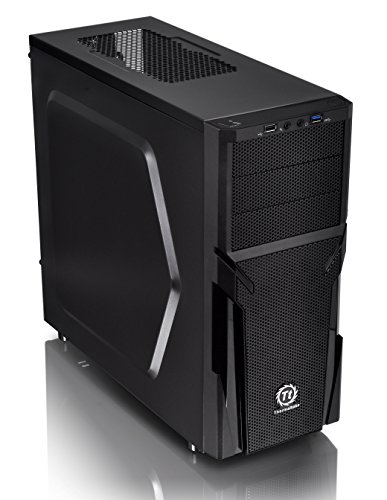
Thermaltake Versa H21 ATX Mid Tower
Best for: Basic ATX builds with mesh airflow
- Motherboard Support
- ATX
- Case Type
- Mid Tower
- Dimensions
- 18.7 × 8.2 × 16.9 inches
- Weight
- 9.3 pounds
View on Amazon: Thermaltake Versa H21 ATX Mid Tower Affiliate link
The Thermaltake Versa H21 is an ATX mid tower case with a perforated mesh front and top panel for airflow. It supports standard ATX motherboards and includes tool-free installation. The chassis measures 18.7 inches long and weighs 9.3 pounds. It features USB 3.0 and audio ports on the top panel. This case suits gamers seeking basic ventilation and straightforward assembly.
Pros
- Perforated metal mesh front and top panel for heat dissipation
- Tool-free installation for easier building
- SuperSpeed USB 3.0 and USB 2.0 ports on top panel
- Supports ATX motherboards and liquid cooling systems
Cons
- Only one USB 3.0 port available
- No mention of included case fans
- Standard ATX support limits E-ATX motherboard compatibility
Good fit if
- You need an ATX mid tower with mesh ventilation
- You prefer tool-free case assembly
- You want top-mounted USB 3.0 connectivity
Skip if
- You require E-ATX motherboard support
- You need pre-installed case fans
- You want multiple USB 3.0 ports
Verdict: The Thermaltake Versa H21 ATX Mid Tower offers solid airflow with its mesh panels and straightforward tool-free assembly. It fits builders who prioritize basic ventilation and simple construction over advanced features.
Specifications side by side
| Spec | Fractal Design Core Micro ATX Case | Thermaltake Versa H21 ATX Mid Tower |
|---|---|---|
| Motherboard Support | Micro ATX | ATX |
| Case Type | not stated | Mid Tower |
| Max GPU Length | Up to 350mm (210mm with HDD tray) | not stated |
| Tower Size | not stated | Mid-Tower |
| Dimensions | 16.5 × 6.8 × 13.9 inches | 18.7 × 8.2 × 16.9 inches |
| Weight | 8 pounds | 9.3 pounds |
| Color | Black | Black |
| Model | FD-CA-CORE-1000-BL | CA-1B2-00M1NN-00 |
| Size | not stated | H21 |
Frequently asked questions
Can I fit a full ATX motherboard in the Fractal Design Core 1000?
No. This chassis is designed exclusively for Micro ATX motherboards. You cannot install standard ATX boards in this case. The internal layout and mounting points are sized specifically for the smaller Micro ATX form factor. If you require ATX support, you should look at the Thermaltake Versa H21 instead.
What are the exact dimensions of the Thermaltake Versa H21?
The Thermaltake Versa H21 measures 8.2 inches in width, 16.9 inches in height, and 18.7 inches in length. These dimensions define its mid-tower form factor. You can use these measurements to verify that the case fits within your desk space or computer room. The weight is listed at 9.3 pounds.
Which case is lighter for easy transport?
The Fractal Design Core 1000 is the lighter option. It weighs 8 pounds. The Thermaltake Versa H21 weighs 9.3 pounds. The difference is 1.3 pounds. If you move your PC frequently, the Fractal Design model offers a slight advantage in portability due to its lower mass and compact Micro ATX design.
Does the Fractal Design Core support long graphics cards?
Yes. This case is best for builds requiring long GPUs within a compact Micro ATX footprint. The internal length allows for extended video cards. You should verify your specific GPU length against the case dimensions to ensure a proper fit. It is not suitable for tall coolers or larger ATX systems.
Is the Thermaltake Versa H21 a mid-tower or full tower?
It is a mid-tower case. The product data explicitly categorizes it as a mid-tower. This size is standard for ATX motherboards. It provides enough room for standard components while fitting on most desks. It does not have the expanded volume of a full-tower chassis.
What color options are available for these specific models?
Both the Fractal Design Core 1000 and the Thermaltake Versa H21 are available in black. The Fractal Design model is listed as black. The Thermaltake model is also listed as black. You do not need to look for white or red variants in this specific comparison.