Fractal Design or ASUS? PC Cases Compared in 2026
As an Amazon Associate we earn from qualifying purchases. Links on this page are affiliate links.
Choosing between an ASUS vs fractal design PC case depends on your build size. Both brands focus on durability and airflow for gaming setups. The Fractal Design Core 1000 is a compact Micro ATX chassis. The ASUS TUF Gaming GT501 is a large E-ATX full-tower. You need to decide if you prefer a small footprint or maximum expansion room. This comparison looks at the specs that matter for your hardware fit.
Key differences
| Aspect | Fractal Design Core Micro ATX Case | ASUS TUF Gaming E-ATX Full-Tower Case |
|---|---|---|
| Motherboard Support | Micro ATX | E-ATX |
| Tower Size | Compact | Full-Tower |
| Side Panel | Not listed | Tempered Glass |
| Radiator Support | Not listed | 360mm |
| Weight | 8 pounds | 26.2 pounds |
Which one should you choose?
Choose Fractal Design Core Micro ATX Case if
- You want a small case that fits on smaller desks.
- You are building with Micro ATX motherboards.
- You prefer a lighter chassis that is easier to move.
Choose ASUS TUF Gaming E-ATX Full-Tower Case if
- You need room for large E-ATX motherboards.
- You want to use a 360mm liquid cooling radiator.
- You prefer a tempered glass side panel for viewing.
Verdict: The Fractal Design Core 1000 suits builders who want a compact, lightweight Micro ATX system. The ASUS TUF Gaming GT501 is better for those needing extensive expansion space and E-ATX support. Your choice depends entirely on your motherboard size and cooling needs.
Fractal vs ASUS Case Specs
motherboard support
The Fractal Design Core 1000 supports Micro ATX motherboards. This limits you to smaller, more compact builds. The ASUS TUF Gaming GT501 supports E-ATX motherboards. This allows you to install larger, high-end boards with more expansion slots. If you need room for extensive connectivity or multiple graphics cards, the ASUS chassis provides the necessary physical space. The Fractal Design case is strictly for smaller form factors. This is a clear advantage for large builds.
tower size
The Fractal Design Core 1000 is a compact Micro ATX case. It measures 16.5 inches in length, 13.9 inches in height, and 6.8 inches in width. It weighs 8 pounds. The ASUS TUF Gaming GT501 is a Full-Tower case. It is significantly larger and heavier at 26.2 pounds. The GT501 requires much more desk or floor space. You must ensure your setup can accommodate this massive footprint. The Fractal Design unit is much easier to fit in tight spaces.
radiator support
The ASUS TUF Gaming GT501 supports radiators up to 360mm in size. It allows mounting on the top or front of the case. It also supports a 140mm radiator at the rear. This gives you flexible options for liquid cooling loops. The Fractal Design Core 1000 data does not list specific radiator mounting points or sizes. You should check the manual for small AIO compatibility. The ASUS case offers superior cooling flexibility for liquid systems.
side panel
The ASUS TUF Gaming GT501 features a 4mm-thick smoked, tempered-glass full view side panel. This allows you to see the internal components and RGB lighting clearly. The Fractal Design Core 1000 data does not specify the side panel material. It may use steel or plastic. If you want to showcase your build hardware, the ASUS glass panel is the better choice. The tempered glass also adds structural rigidity to the chassis.
gpu length
The Fractal Design Core 1000 supports graphics cards up to 350mm in length. This is possible only if you use the top HDD slot in the removable tray. If you use both slots, support drops to 210mm. The ASUS TUF Gaming GT501 data does not list specific maximum GPU lengths. However, its Full-Tower design typically accommodates very large cards. Without specific numbers for the ASUS, the Fractal Design offers a clear, verified limit for your purchase.
Which Fractal or ASUS case suits you
Small form factor builders needing compact storage
The Fractal Design Core 1000 fits Micro ATX boards in a tight footprint. Its removable HDD tray allows vertical mounting with anti-vibration grommets. You can install graphics cards up to 350mm long if you use only one drive slot. This design keeps your system small while maintaining decent component clearance.
Gamers wanting large builds with extensive cooling
The ASUS TUF Gaming GT501 supports E-ATX motherboards and includes three 120mm RGB fans plus a 140mm rear fan. It accepts 360mm radiators on the top or front. The tempered glass side panel offers a full view of your components. This full-tower chassis provides ample space for high-end hardware and liquid cooling setups.
Users prioritizing portability and transport safety
The ASUS TUF Gaming GT501 features ergonomic woven-cotton carry handles. These handles allow you to safely transport the case, which weighs up to 65lbs. The sturdy metal chassis and panels ensure durability during moves. This feature is unique to the ASUS model and simplifies transporting a heavy, fully equipped gaming rig.
The products compared

Fractal Design Core Micro ATX Case
Best for: Compact Micro ATX builds needing long GPU support
- Motherboard Support
- Micro ATX
- Max GPU Length
- Up to 350mm (210mm with HDD tray)
- Dimensions
- 16.5 × 6.8 × 13.9 inches
- Weight
- 8 pounds
View on Amazon: Fractal Design Core Micro ATX Case Affiliate link
The Fractal Design Core 1000 is a compact Micro ATX case designed for performance-focused builds. It supports graphics cards up to 350mm and CPU coolers up to 135mm. The removable HDD tray allows vertical mounting with anti-vibration grommets. Measuring 16.5 by 13.9 by 6.8 inches, it offers a practical footprint. You get a sturdy 8-pound chassis in black. This case suits users prioritizing component clearance in a smaller form factor.
Pros
- Supports graphics cards up to 350mm long
- Accepts CPU coolers up to 135mm in height
- Removable HDD tray with vertical mounting option
- Compact Micro ATX form factor
Cons
- GPU clearance drops to 210mm when using both HDD slots
- Limited to Micro ATX motherboards only
- Single color option available
Good fit if
- You need a compact case for Micro ATX builds
- You require long graphics card support
- You want vertical HDD mounting flexibility
Skip if
- You plan to use an E-ATX motherboard
- You need support for larger form factors
- You require extensive RGB customization
Verdict: Fractal Design Core 1000 Micro ATX Case provides strong component clearance for its size. It fits builders who want a compact Micro ATX chassis without sacrificing GPU or cooler compatibility.
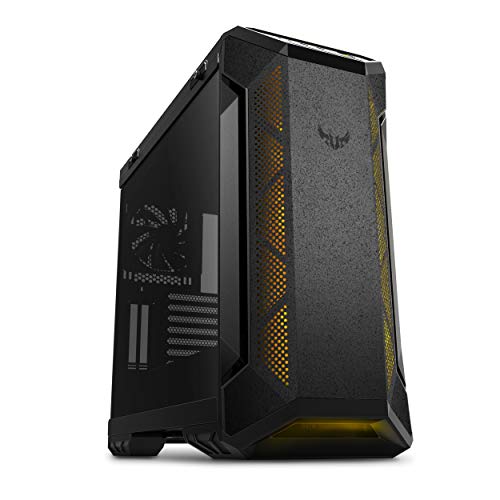
ASUS TUF Gaming E-ATX Full-Tower Case
Best for: Large E-ATX builds with liquid cooling needs
- Motherboard Support
- E-ATX
- Case Type
- Full-Tower
- Side Panel
- Tempered Glass
- Radiator Support
- 360mm
- Max GPU Length
- 420mm
- Fan Size
- 120mm, 140mm
View on Amazon: ASUS TUF Gaming E-ATX Full-Tower Case Affiliate link
The ASUS TUF GT501 is a full-tower case designed for E-ATX motherboards. It includes three 120mm ARGB fans and one 140mm rear fan for cooling. The chassis supports 360mm radiators on the top or front. A tempered glass side panel offers a clear view of components. Woven-cotton handles allow you to carry the 26.2-pound case safely. This build suits gamers needing extensive expansion slots and liquid cooling options.
Pros
- Supports E-ATX motherboards in a full-tower chassis
- Includes four pre-installed fans with ARGB lighting
- Accepts 360mm radiators on top or front panels
- Features vertical GPU mounting plus seven traditional slots
Cons
- Heavy at 26.2 pounds, requiring careful handling
- Dimensions listed in inches appear incorrect for a case
- No mention of included cable management accessories
Good fit if
- You need space for E-ATX motherboards
- You want pre-installed ARGB fans for lighting
- You plan to use large top-mounted radiators
Skip if
- You prefer a smaller mid-tower form factor
- You require a lightweight case for frequent moves
- You only need ATX motherboard support
Verdict: The ASUS TUF GT501 Full-Tower E-ATX is a spacious option for enthusiasts building large systems. It fits users who prioritize E-ATX compatibility and extensive fan mounting points over compact dimensions.
Specifications side by side
| Spec | Fractal Design Core Micro ATX Case | ASUS TUF Gaming E-ATX Full-Tower Case |
|---|---|---|
| Motherboard Support | Micro ATX | E-ATX |
| Case Type | not stated | Full-Tower |
| Side Panel | not stated | Tempered Glass |
| Radiator Support | not stated | 360mm |
| Max GPU Length | Up to 350mm (210mm with HDD tray) | 420mm |
| Tower Size | not stated | Full-Tower |
| Fan Size | not stated | 120mm, 140mm |
| Use | not stated | Gaming |
| Lighting | not stated | RGB |
| Compatible Device | not stated | Radiator |
| Dimensions | 16.5 × 6.8 × 13.9 inches | 215 × 98.8 × 217 inches |
| Weight | 8 pounds | 26.2 pounds |
| Color | Black | GT501|Grey |
| Model | FD-CA-CORE-1000-BL | GT501/GRY/WITH HANDLE |
| Size | not stated | EATX |
Frequently asked questions
Which case is better for a small desk setup?
The Fractal Design Core 1000 is the better choice for tight spaces. Its compact Micro ATX form factor measures 16.5 inches in length. This allows it to fit easily on smaller desks. In contrast, the ASUS TUF GT501 is a full-tower case. It requires significantly more floor space due to its large dimensions.
Can I use the ASUS case for a Micro ATX build?
The ASUS TUF GT501 is designed for E-ATX motherboards. While it physically might accommodate smaller boards, it is not optimized for Micro ATX. The Fractal Design Core 1000 specifically supports Micro ATX. It is built to maximize space efficiency for that specific motherboard size. You will get a tighter fit with the Fractal option.
How much space does the Fractal Design Core take up?
The Fractal Design Core 1000 has a footprint of 16.5 inches in length. It is 13.9 inches high and 6.8 inches wide. This compact size makes it suitable for builders who need strong component clearance without a large chassis. It weighs 8 pounds, making it relatively lightweight for its class.
What motherboard sizes does the ASUS TUF GT501 support?
The ASUS TUF Gaming GT501 supports E-ATX motherboards. This allows you to install large, high-end boards with extensive expansion slots. It is categorized as a full-tower case. This design prioritizes space for large components and cooling solutions over compactness. It is ideal for enthusiasts building expansive systems.
Which case is heavier and easier to move?
The Fractal Design Core 1000 is lighter and easier to move. It weighs 8 pounds. The ASUS TUF GT501 is significantly heavier at 26.2 pounds. This weight difference reflects the larger materials and structure of the full-tower design. You will find the Fractal case more manageable for temporary setups or frequent relocations.
Is the ASUS case suitable for small form factor builds?
No, the ASUS TUF GT501 is not suitable for small form factor builds. It is a full-tower case designed for E-ATX motherboards. Its dimensions are large and intended for spacious environments. If you need a compact chassis, the Fractal Design Core 1000 is the appropriate choice. It is built specifically for Micro ATX builds.